
You can spend months configuring sales pipelines, custom fields, and stage automations, yet still watch your reps struggle to book discovery calls. Software alone does not generate revenue. When sales pipelines stall, teams often blame tooling instead of data quality, targeting, or process discipline. Evaluating salesforce vs zoho CRM is really about how software architecture, pricing models, and data governance impact lead generation ROI. According to market intelligence reports published by IDC recently, Salesforce holds between 21 and 23 percent of the worldwide CRM software market. Zoho CRM offers a much lower financial barrier to entry for smaller businesses.
Salesforce vs Zoho CRM is a software comparison between two leading customer relationship management platforms that evaluates cost, customization, and scalability. This comparison matters because choosing the right CRM ensures your sales team operates efficiently, maintains clean prospect records, and achieves a strong return on your outbound technology investments.
Teams seeking growth often pair these systems with verified external prospect intelligence accessed through Go4Database to fuel clean pipeline generation. The practical question is how each tool manages external prospect data, workflow automation, and day-to-day administrative overhead.
Salesforce vs Zoho CRM: Key Features and Differences Compared
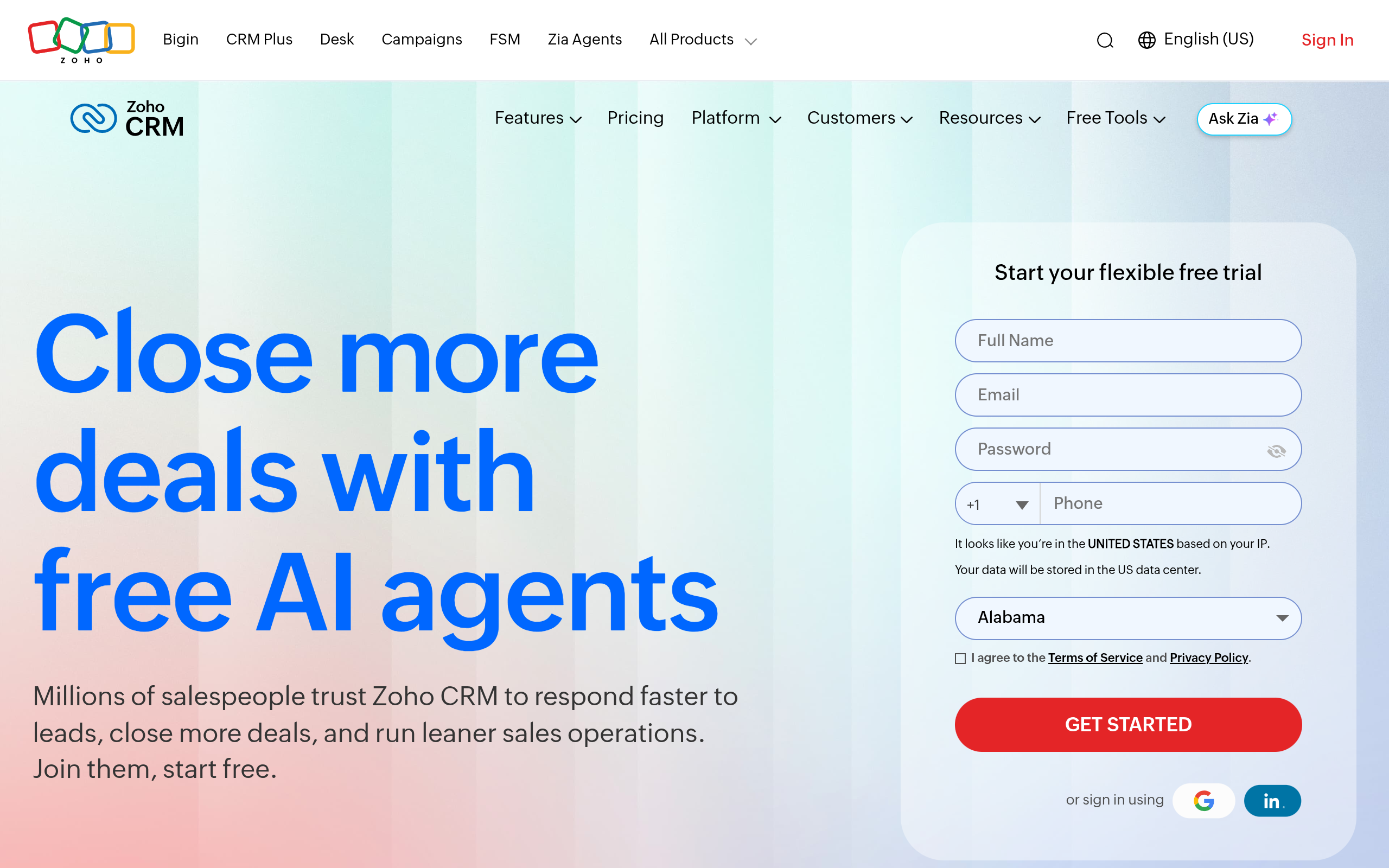
Zoho CRM's homepage as of October 2026.
At its core, a CRM serves primarily as a system of record. It organizes customer accounts, tracks deal stages, and records team communication across touchpoints.
Many founders assume their CRM will handle cold outbound prospecting right out of the box. In practice, uploading large prospect lists directly into either platform without planning causes operational friction.
A recent benchmark survey published by Demand Gen Report found that more than 55 percent of B2B revenue teams face data ingestion friction. Most of it comes down to duplicate conflicts and permission rules.
Salesforce Sales Cloud
Salesforce Sales Cloud's homepage as of October 2026.
Salesforce Sales Cloud is built to manage complex revenue operations, lead tracking, and multi-tier account hierarchies. If you need the background first, read our guide on what is salesforce to see how its architecture works.
It supports complicated sales cycles that span multiple departments. Teams get deep API connections for custom workflows, alongside detailed reporting built for formal corporate governance.
The trade-off is administrative overhead. Setup takes time, you usually need a dedicated administrator, and data storage fees can climb quickly if you import large volumes of raw prospect lists.
Best for: Mid-market and enterprise sales teams that require custom system architecture, strict governance, and dedicated technical administration.
Zoho CRM
Zoho CRM is built to manage lead pipelines, multi-channel customer communications, and routine sales tasks without heavy technical overhead. Sales generalists can deploy the intuitive interface quickly without formal engineering support.
It provides predictable subscription pricing with minimal hidden fees and straightforward contact storage expansions. That makes it easier to budget without worrying about sudden cost spikes.
On the downside, native mass email sending remains restricted by daily per-user volume caps. The interface can also feel fragmented across distinct Zoho modules, and developer community resources lag behind larger enterprise rivals.
Best for: Startups, lean sales teams, and cost-conscious operators seeking an intuitive, full-featured CRM without enterprise implementation fees.
When you evaluate zoho salesforce capabilities, data storage limits quickly emerge as a hidden expense. Uploading a file of 100,000 raw prospect records into Salesforce can trigger sudden add-on costs.
Zoho CRM handles raw contact storage with much lower baseline penalties.
Pro tip: Clean and verify every external lead list with an email verifier before importing records to avoid wasting CRM database storage on inactive accounts.
TL;DR:
When comparing salesforce vs zoho CRM on core features, Salesforce delivers deep custom enterprise architecture while Zoho CRM provides accessible, all-in-one sales tracking; teams buying verified prospect records through Go4Database benefit most when storing verified profiles without triggering excessive system bloat.
Salesforce vs Zoho CRM Pricing: Plans, Costs, and Value for Money
Pricing structures reveal a fundamental difference between these two vendors. Software review portal Capterra notes in its recent CRM buyer analysis that total ownership costs differ significantly beyond initial user licenses.
In a recent pricing study, Method CRM reported that Salesforce raised list prices by about 6 percent on Enterprise and Unlimited tiers. That change pushed Enterprise seats to roughly $165 to $175 per user monthly when billed annually.
Add-on features compound these totals quickly, as outlined in our guide to salesforce pricing.
In contrast, recent public pricing from Zoho shows Standard at $14, Professional at $23, Enterprise at $40, and Ultimate at $52 per user monthly on annual terms.
The gap widens further when you examine record storage limits. Salesforce Sales Cloud Enterprise provides a base storage allocation of 10 GB plus 20 MB per user license.
Official Salesforce Help documentation indicates that supplemental data storage blocks are generally billed at rates reaching an estimated $125 per month for each 500 MB block. Exact pricing depends on the contract.
Official Zoho Help documentation indicates Zoho CRM provides 1 GB of shared storage plus user allocations, charging roughly $4 per month for 5 GB expansion blocks. For teams storing high contact volumes, that distinction matters in practice.
| Metric / Feature | Salesforce Sales Cloud | Zoho CRM | Outbound Data Impact |
|---|---|---|---|
| Base Starting Price (Annual) | ~$25/user/mo (Starter Suite); ~$165-$175/user/mo (Enterprise) | $14/user/mo (Standard); $40/user/mo (Enterprise) | Zoho significantly lowers entry barrier for bootstrapped teams |
| Base Data Storage Included | 10 GB org base + 20 MB per Enterprise user | 1 GB org base + 512 MB to 1 GB per user | Large external prospect imports quickly exceed base Salesforce tiers |
| Supplemental Storage Cost | Estimated up to $125/mo per 500 MB block | About $4/mo per 5 GB block | Salesforce storage overages can exceed software licensing fees |
| Autonomous AI / Agents | Agentforce options starting around $550/user/mo or usage credits | Zia AI included natively on Enterprise/Ultimate | Salesforce targets enterprise automation; Zoho targets daily utility |
| Native Mass Outbound Sends | Prohibited for cold lists via Marketing Cloud AUP | Capped at 1,000 emails/user/day (Enterprise); strict AUP | Neither allows cold list blasts; external sequencers required |
| Implementation Overhead | Often requires technical administrator or partner | Can be deployed by a revops generalist in 1 to 2 weeks | Zoho cuts secondary overhead for small teams |
Deciding between zoho or salesforce requires looking beyond the monthly software license. A 15-person sales team on Salesforce Enterprise commits roughly $30,000 annually just for licenses. That same team pays about $7,200 annually on Zoho CRM Enterprise.
There is also the staffing footprint to consider. Salesforce deployments frequently demand an internal administrator or an external implementation partner. Zoho CRM allows an operational generalist to configure stages, rules, and dashboards directly.

Maximize Your CRM Investment With Accurate Data
Power your chosen platform with verified B2B contact data from Go4Database to protect your overall software return.
Salesforce vs Zoho CRM: Sales Automation, Integrations, and Customization
Workflow automation keeps your sales team focused on high-value conversations rather than manual record keeping. Salesforce Flow provides programmatic control, allowing administrators to update related records across custom objects.
Zoho Blueprint takes a visual approach instead. It enforces stage-by-stage routines that keep reps from advancing deals without required notes.
Artificial intelligence features also reflect these separate product tiers. In a recent product breakdown, MarketBetter notes that Salesforce introduced Agentforce 1 Sales options priced around $550 per user monthly for autonomous actions.
That tier also carries consumption credits estimated around $0.10 per action. By comparison, Zoho includes its Zia predictive engine natively on Enterprise and Ultimate tiers to surface anomaly detection and deal win probabilities without extra per-action token fees.
There is an important distinction here regarding outbound messaging. Technical standards outlined by the Internet Engineering Task Force establish strict requirements for sending domains.
These protocols include SPF to authenticate sending IP addresses, DKIM for cryptographic verification, and DMARC to set validation policies.
Guidelines published by Google Workspace Support also require bulk senders to keep spam complaint rates below 0.10 percent and avoid exceeding 0.30 percent.
Zoho CRM caps native mass emails at 1,000 messages per user daily on Enterprise plans. Meanwhile, Salesforce Marketing Cloud terms prohibit unverified third-party prospect lists in its acceptable use rules.
Pro tip: Keep your CRM as a clean system of record, and execute cold outreach cadences through dedicated outbound sequencers to protect your primary domain reputation.
TL;DR:
In the salesforce vs zoho CRM automation matchup, Salesforce delivers enterprise-wide programmatic orchestration while Zoho provides straightforward visual process control; savvy operators pair both with verified phone and email intelligence from Go4Database to ensure clean operational pipelines.
Salesforce vs Zoho CRM for Small Businesses and Growing Enterprises
A common mistake is buying enterprise software before your sales motion warrants it. When zoho compared to salesforce comes up for early-stage teams, the pricing difference is immediate.
Published rates from SaaS directory Spotsaas recently list Zoho One at roughly $37 per employee monthly on an all-employee contract. That bundle combines CRM tools with dozens of connected business applications.
Small teams often find entry plans like Salesforce Starter Suite approachable at list rates around $25 per user monthly. Upgrading to custom fields and deeper automation increases expenses rapidly, much like the tradeoffs seen in salesforce vs hubspot.
Zoho CRM is relevant when: A startup or growing business needs an affordable revenue system that launches quickly. It suits teams storing high volumes of prospect data without heavy storage fees or a full-time certified developer.
Salesforce is relevant when: An established mid-market or enterprise organization has complex partner hierarchies and strict governance needs. It also demands budget for specialized agencies or dedicated administrators, who command between $90,000 and $130,000 annually according to salary surveys.
Fuel Your Sales Growth Across Any CRM
Get verified B2B contact data from Go4Database to help your growing team connect with ideal prospective buyers.
Apollo.io
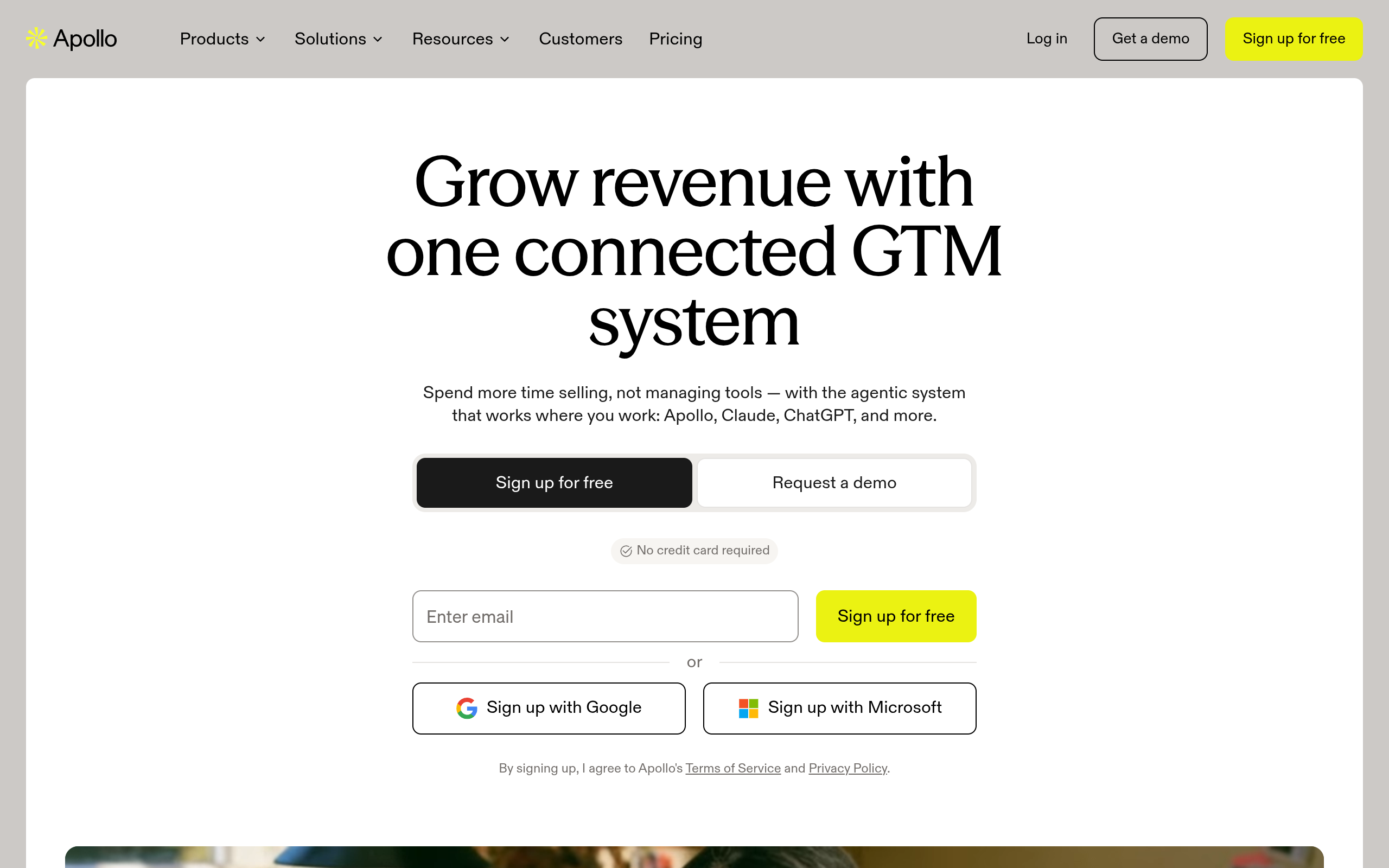
Apollo.io's homepage as of October 2026.
Apollo.io combines a B2B contact directory with email sequencing and built-in dialers, as noted on G2. If you examine apollo pricing, entry tiers generally run from roughly $49 to $99 per user monthly.
Having lead searching and outreach cadences in one place saves reps from configuring complex API connections. It simply gets outbound campaigns moving quickly.
There is an important distinction here, though. Apollo lacks the deep relational database architecture of traditional CRMs. Direct dial records can also be outdated in niche industries, and post-sale reporting remains basic.
Best for: Lean outbound sales teams that focus on prospecting volume and email cadences over multi-stage enterprise account management.
HubSpot Sales Hub
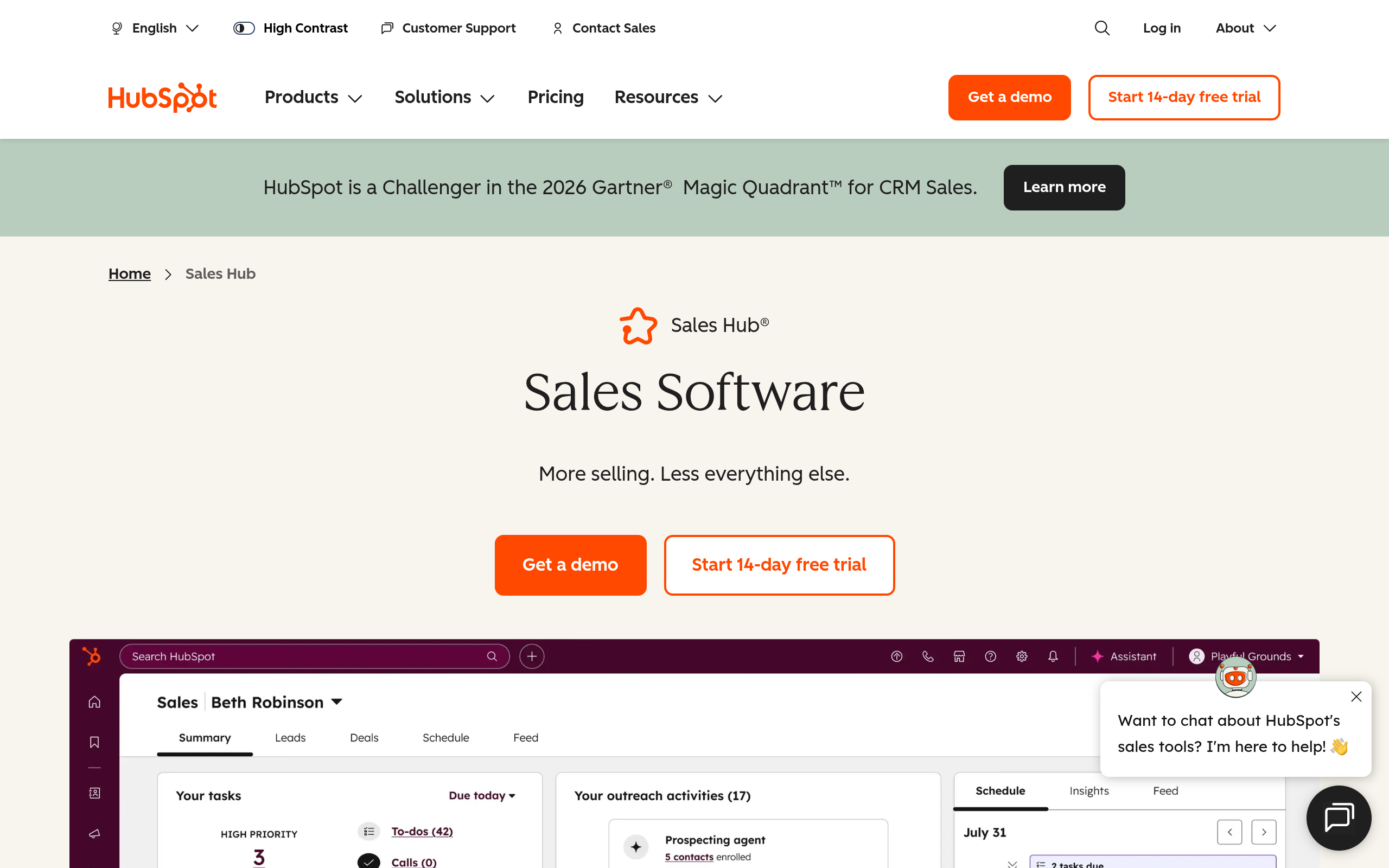
HubSpot Sales Hub's homepage as of October 2026.
HubSpot Sales Hub unifies marketing attribution, inbound lead capture, and deal management without complex code. A clean user experience helps new reps get up to speed quickly.
It connects inbound forms directly to sales deals and requires very little technical maintenance compared to enterprise platforms. That keeps daily pipeline tracking simple for lean teams.
The catch is cost. Seat pricing climbs steeply on Professional tiers to roughly $90 to $100 per user monthly based on published rates.
Data flexibility is another limitation. Custom relational modeling is more restricted than Salesforce, and marketing contact tiers penalize companies storing large inactive lists.
Best for: Mid-market businesses focused on inbound pipeline generation that want enterprise power without hiring full-time database administrators.
Brevo
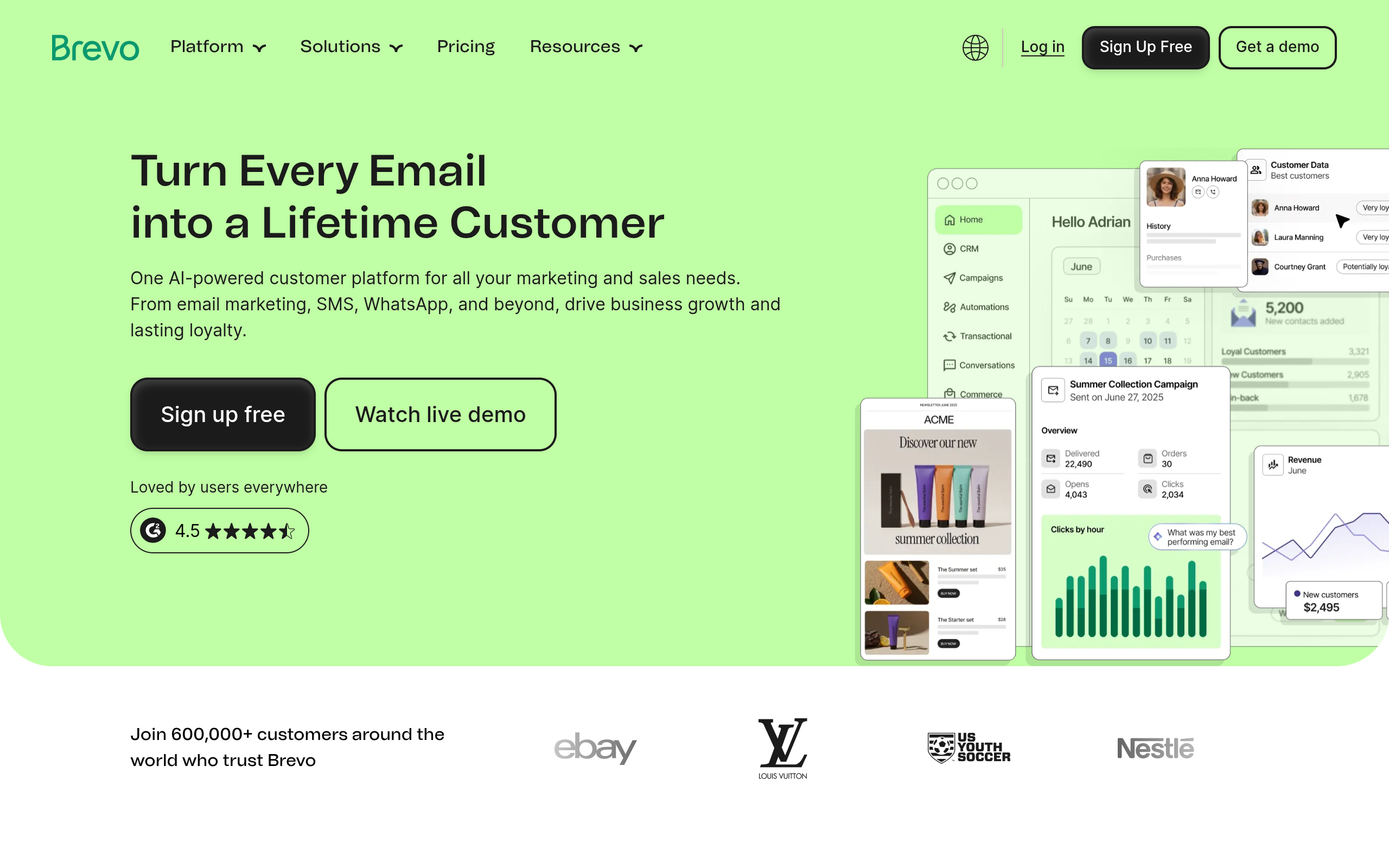
Brevo's homepage as of October 2026.
Brevo handles transactional messaging, email campaigns, and lightweight CRM deal tracking. In simple terms, it works as a communications platform, with user feedback documented across TrustRadius.
The platform provides a free entry plan, with paid messaging tiers scaling roughly from $9 to $65 monthly based on email volume. Standard plans also include unlimited team seats alongside native SMS and WhatsApp channels.
However, the deal pipelines remain basic. You will not find advanced stage governance, custom object hierarchies for complex operations, or deep integrations with enterprise databases.
Best for: Bootstrapped companies and service agencies needing flexible user seats and reliable bulk marketing delivery on a modest budget.
Populate Your Pipeline With Reliable Leads
Acquire verified B2B contact records from Go4Database so your reps can start pitching decision makers right away.
Salesforce vs Zoho CRM: Pros, Cons, and Which CRM Should You Choose
When comparing salesforce and zoho, the deciding factor is often everyday operational friction. Market research from Gartner shows that user adoption and regular data maintenance drive CRM returns far more than raw feature counts.
Zoho offers quick setup and budget-friendly database expansion, while Salesforce provides deep customization for complex organizations. For teams weighing broader market options, reviewing a top salesforce alternative can help clarify what you actually need.
Comparing zoho crm vs salesforce over three years highlights the financial reality. A 15-person team on Zoho Enterprise spends around $21,600 in licensing, whereas Salesforce Enterprise licensing exceeds $90,000 before consulting hours.
Storing large, raw contact lists also drives up Salesforce costs through higher storage rates. A common question is whether you should import cold lists directly into either system.
While both platforms accept CSV uploads, native tools forbid unsolicited email blasts. Cold outreach works best in a dedicated sending tool, filtering only warm, responsive leads into your primary CRM.
For targeted campaigns, teams often source specialized lists like a crm providers database to reach vertical markets directly. Even so, switching software will not fix outbound performance if the contact records are inaccurate.
Rather than manual scraping, Go4Database states it lists more than 400 million business contacts and 130 million verified mobile numbers across 9,000 industries. Teams can check data accuracy using their built-in email verifier.
You can test prospect records with a free trial of 100 contacts monthly for one year without a credit card. Teams scaling up can use the Micro Active plan at $59 monthly for 3,000 contacts across 10 users.
The Missing Piece: Fueling Your CRM Engine Beyond Software Subscriptions
Software subscriptions do not close deals. Disciplined follow-up and verified targeting do. A sales team with clean data in an accessible CRM will reliably outperform a team running enterprise software packed with outdated records.
Before committing to a long contract, audit your outbound contact quality and separate cold prospecting from your primary CRM. Then choose the platform whose user licenses, storage rules, and daily operational demands align with your actual growth trajectory.
Frequently Asked Questions
You might have these questions in your mind?