On this page 6 sections
- 1. Brevo vs Mailchimp: Key Features and Main Differences
- 2. Brevo vs Mailchimp Pricing: Which Tool Is More Affordable
- 3. Brevo vs Mailchimp for Automation and Email Campaigns
- 4. Brevo vs Mailchimp: Deliverability, Templates, and Ease of Use
- 5. the Two Platforms: Which Email Marketing Platform Is Best for Your Business
- Final Decision Guide for Growing Teams
You can gather thousands of customer addresses and still see your marketing budget disappear into software fees. That frustration is often what leads marketers to compare these two platforms. Choosing between them is not simply a matter of picking a friendlier dashboard. It comes down to how your company gathers leads, how often you email them, and how your billing model scales over time. The comparison between Brevo vs Mailchimp centers on subscriber storage limits versus monthly sending volume. Both tools focus on automated nurturing for opted-in contacts. Teams sourcing verified prospective contacts through Go4Database rely on separate, dedicated infrastructure for initial outbound engagement.
Brevo vs Mailchimp is a comparison between two leading marketing platforms that evaluates contact storage limits against monthly sending volume. This choice matters because it directly affects how your business scales email budgets, automates lead nurturing, and manages customer databases without paying unexpected platform fees.
1. Brevo vs Mailchimp: Key Features and Main Differences
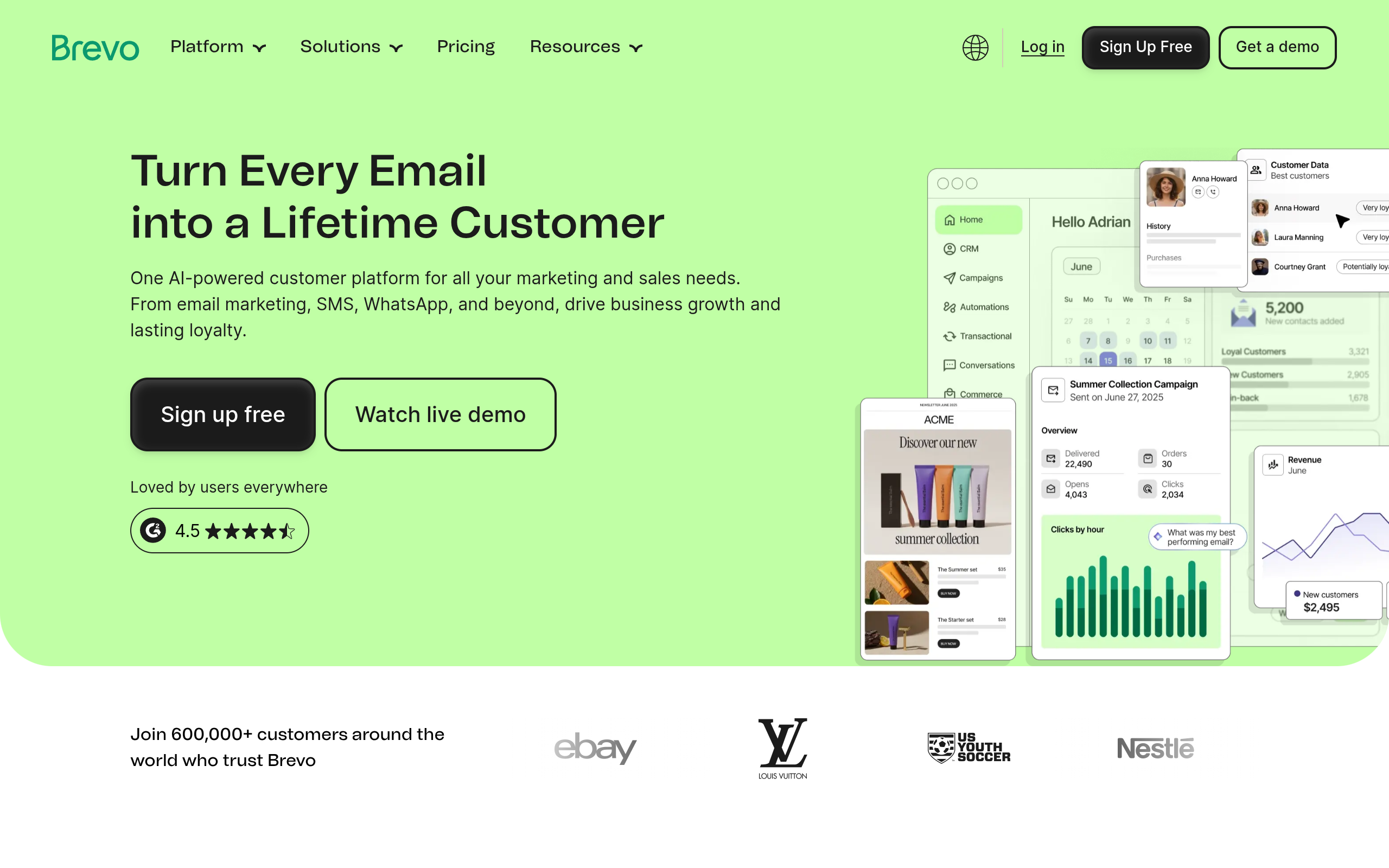
Brevo's homepage as of October 2026.
Both platforms let you build newsletters and automated sequences, but they are designed around different priorities. Brevo focuses on message volume and operational alerts, while Mailchimp centers on subscriber audience data and e-commerce tracking.
Brevo
Brevo takes a broader approach, combining newsletters, SMS alerts, web chat, and a sales CRM in one dashboard. It handles both marketing campaigns and automated operational messages from that single account.
Contact storage is handled differently as well. According to Brevo documentation, the platform allows businesses to store up to 100,000 contacts on its free plan without immediate contact overage charges.
For further reading, consult HubSpot's marketing blog.
- Stores large contact databases without charging for dormant profiles.
- Includes transactional SMTP sending inside normal monthly plans.
- Provides multi-channel communication including email, SMS, and WhatsApp.
- Imposes a strict daily send limit of 300 emails on the free plan.
- Requires a paid upgrade to remove company branding from footers.
- Charges extra monthly fees for additional team member seats.
Best for: Lean service firms, software teams, and agencies that send targeted messages to large lists on a predictable schedule.

Power your email software with verified contacts
Fuel your new marketing platform with accurate, verified B2B contact lists built by Go4Database for higher engagement.
Mailchimp
Mailchimp is an Intuit-owned platform that focuses on behavioral subscriber tracking and multi-channel audience management. It prioritizes predictive buyer segments and visual design over raw sending volume.
Entry limits are quite tight, however. According to Retainful, Mailchimp caps its free tier at 250 contacts and 500 monthly email sends.
- Provides hundreds of direct integrations with online store platforms.
- Features advanced customer journey builders with pre-built sales triggers.
- Offers clean drag-and-drop templates with built-in layout scoring.
- Counts unsubscribed and non-subscribed contacts toward monthly billing limits.
- Separates transactional API relays into an additional paid module.
- Excludes multi-step automation journeys from entry-level and free tiers.
Best for: Direct-to-consumer shops and visual brands with active, engaged subscribers who make frequent purchases.
There is an important distinction here around imported contacts. According to Sparkle.io research, Mailchimp uses an automated compliance filter called Omnivore. It scans newly imported files and can suspend accounts that upload third-party lead lists.
Brevo follows a similarly strict policy. Mailingale notes that Brevo requires provable opt-in consent and will freeze sending if an imported file generates high hard-bounce rates. Neither tool is built to handle raw outbound B2B prospect lists directly.
| Platform Feature | Brevo | Mailchimp |
|---|---|---|
| Primary Billing Basis | Monthly email send volume | Total contacts stored (active and unsubscribed) |
| Free Tier Limits | 300 sends per day, up to 100,000 contacts (Brevo documentation) | 250 contacts, 500 sends per month (Retainful) |
| Transactional SMTP / API | Bundled in standard send quotas | Separate paid add-on from $20 per month (Rework) |
| Automations on Free | Basic automated sequences included | No automated journeys on free plan (Retainful) |
| Compliance Scanning | Automated bounce rate and complaint monitoring | Omnivore algorithmic list verification (Sparkle.io) |
| Team User Seats | Add-on purchase starting at $12 per month | Tier dependent (1 seat on Essentials, 5 on Standard) |
TL;DR:
Brevo bills on monthly message volume with bundled transactional tools, while Mailchimp bills on stored audience profiles with deep e-commerce segmentation.
2. Brevo vs Mailchimp Pricing: Which Tool Is More Affordable
Your actual cost usually depends on how each platform counts your audience. When evaluating Mailchimp vs Brevo, standard monthly pricing rarely tells the whole story.
There is an important distinction here. Brevo charges based on how many emails you send, while Mailchimp charges for the total contacts stored in your account.
For further reading, consult Statista statistics.
According to Brevo's official pricing page, the Starter tier begins at $9 per month for 5,000 monthly sends. The Standard tier starts at $18 per month for 5,000 sends with advanced testing.
By comparison, Mailchimp Essentials begins at $13 per month for just 500 contacts. Its Standard plan costs $20 per month for that same 500-contact tier.
The gap expands rapidly as an audience grows. Dreamlit AI research shows that sending weekly emails to 5,000 contacts (20,000 monthly messages) costs $32 per month on Brevo Starter.
That same schedule costs $75 per month on Mailchimp Essentials. On Mailchimp Standard, that cost rises to $100 per month.
Pro tip: Regularly archive unsubscribed contacts inside Mailchimp to avoid paying higher monthly rates for people who can no longer receive your messages.
Mailchimp Documentation confirms that all stored profiles count toward your billing tiers, including unsubscribed and non-subscribed contacts. If an address remains in your audience, you pay for it until an admin manually archives the record.
Maximize your email marketing return on investment
Lower your acquisition costs by importing clean, verified B2B lead lists from Go4Database directly into your software.
According to Retainful, Intuit applied an 11% to 13% price increase across legacy Mailchimp accounts created before May 2019. Regular list maintenance becomes practical when every inactive contact pushes you toward a higher tier.
Brevo has its own tradeoff. If your team emails a small audience daily, you burn through send limits quickly. Reaching 1,000 subscribers every day uses 30,000 monthly sends, which narrows Brevo's cost advantage.
Transactional messages introduce another cost factor. According to Rework, sending receipts through Mailchimp requires paid blocks starting at $20 per month for 25,000 sends. Brevo includes transactional SMTP inside standard plan quotas.
Understanding your actual sending cadence protects your marketing ROI from unexpected overages. Teams reviewing overall Mailchimp pricing models often rethink how they manage audience records.
For further reading, consult Litmus deliverability research.
TL;DR:
Brevo delivers lower costs for growing lists sent on a weekly schedule, while Mailchimp inflates bills by charging for inactive contacts.
3. Brevo vs Mailchimp for Automation and Email Campaigns
Building automated workflows requires a balance of clear logic and sensible timing. In practice, how each platform structures customer journeys will shape your day-to-day work.
Mailchimp provides a clean visual journey builder. It features straightforward triggers for familiar e-commerce milestones, including abandoned shopping carts, product page views, and win-back emails.
Brevo takes a more functional, rules-based approach. You can map multi-branch paths based on custom attributes, link clicks, or lead scores. The initial setup takes longer, but it handles service inquiries and operational alerts reliably.
Pro tip: Connect form fills directly to webhook triggers in Brevo to launch confirmation sequences without waiting for batch sync delays.
Many teams run into trouble when using these platforms for cold sales outreach. The US Federal Trade Commission explains in its CAN-SPAM Act guide that unsolicited commercial messages are permissible with accurate sender headers and clear opt-out links.
However, both Brevo and Mailchimp enforce private terms of service that strictly ban unverified third-party data. Uploading cold lists risks your sending reputation and can trigger immediate account reviews.
Outbound growth requires dedicated sending tools designed for cold outreach, supported by accurate prospective records. According to Go4Database's site, the provider lists over 400 million global business contacts and 130 million verified mobile numbers across 9,000 industries.
Sourcing a marketing decision maker list helps sales reps connect directly with buyers using outbound platforms. Once those prospects reply and confirm their interest, you can add them to Brevo or Mailchimp for ongoing nurturing.
This division protects your newsletter sender score while keeping inbound funnels compliant.
For further reading, consult Validity sender reputation data.
Teams building complete B2B email marketing strategies often separate initial prospecting from regular newsletter management. Many also use AI email marketing tools to help draft those sequences.
TL;DR:
Mailchimp leads in visual e-commerce automation, while Brevo excels at functional lead qualification. Neither tool permits raw cold list imports.
4. Brevo vs Mailchimp: Deliverability, Templates, and Ease of Use
A message only creates value if it lands in the primary inbox. Getting it there requires following specific technical standards.
Google and Yahoo enforce strict bulk sender rules, as documented by Chronos Agency. Senders must authenticate custom domains, keep spam complaint rates below 0.10%, and never reach 0.30%.
Meeting these standards requires SPF, a DNS record showing which servers may send email for your domain. It also requires DKIM, a signature proving messages were not altered in transit.
DMARC then tells receiving servers how to handle emails that fail those checks. Both platforms also support RFC 8058, which places a one-click unsubscribe button directly at the top of the message.
On entry-level tiers, both systems place your account on a shared IP address alongside thousands of other businesses. A sudden burst of spam complaints from another sender can temporarily hurt inbox placement for everyone on that pool.
Brevo sends transactional notices and marketing broadcasts through the same infrastructure on entry tiers. A poorly targeted promotional blast could delay important password resets unless you purchase a dedicated IP address.
For further reading, consult Twilio SendGrid's deliverability blog.
Mailchimp separates marketing newsletters from transactional API delivery by default. That protects critical alerts, though it increases your overall software costs.
On template design, Mailchimp offers a polished drag-and-drop editor with rich formatting options and dynamic product cards. Brevo provides a clean builder that focuses on mobile responsiveness and lightweight code.
Marketers running a targeted email marketing campaign clean subscriber records before sending to prevent bounce spikes. Sourcing pre-verified records from an established marketing mailing list helps protect domain reputation across both platforms.
TL;DR:
Both platforms meet modern Google and Yahoo authentication standards, but Mailchimp provides a more polished template design experience.
5. the Two Platforms: Which Email Marketing Platform Is Best for Your Business
Choosing between these two platforms usually comes down to your list size, your team size, and your commercial model.
Here is when Brevo fits your business best:
- You want predictable monthly bills based on message volume rather than audience size.
- You manage both marketing newsletters and system alerts through a single dashboard.
- You maintain a large subscriber list that you contact once a week or twice a month.
Here is when Mailchimp fits your business best:
- You operate a consumer online store that relies on cart abandonment triggers.
- Your marketing team prioritizes visual design templates and flexible layout customization.
- You need direct integrations with a broad catalog of e-commerce web applications.
Mailchimp Competitors
If neither tool fits how your team works, several credible mailchimp competitors offer practical alternatives.
ActiveCampaign
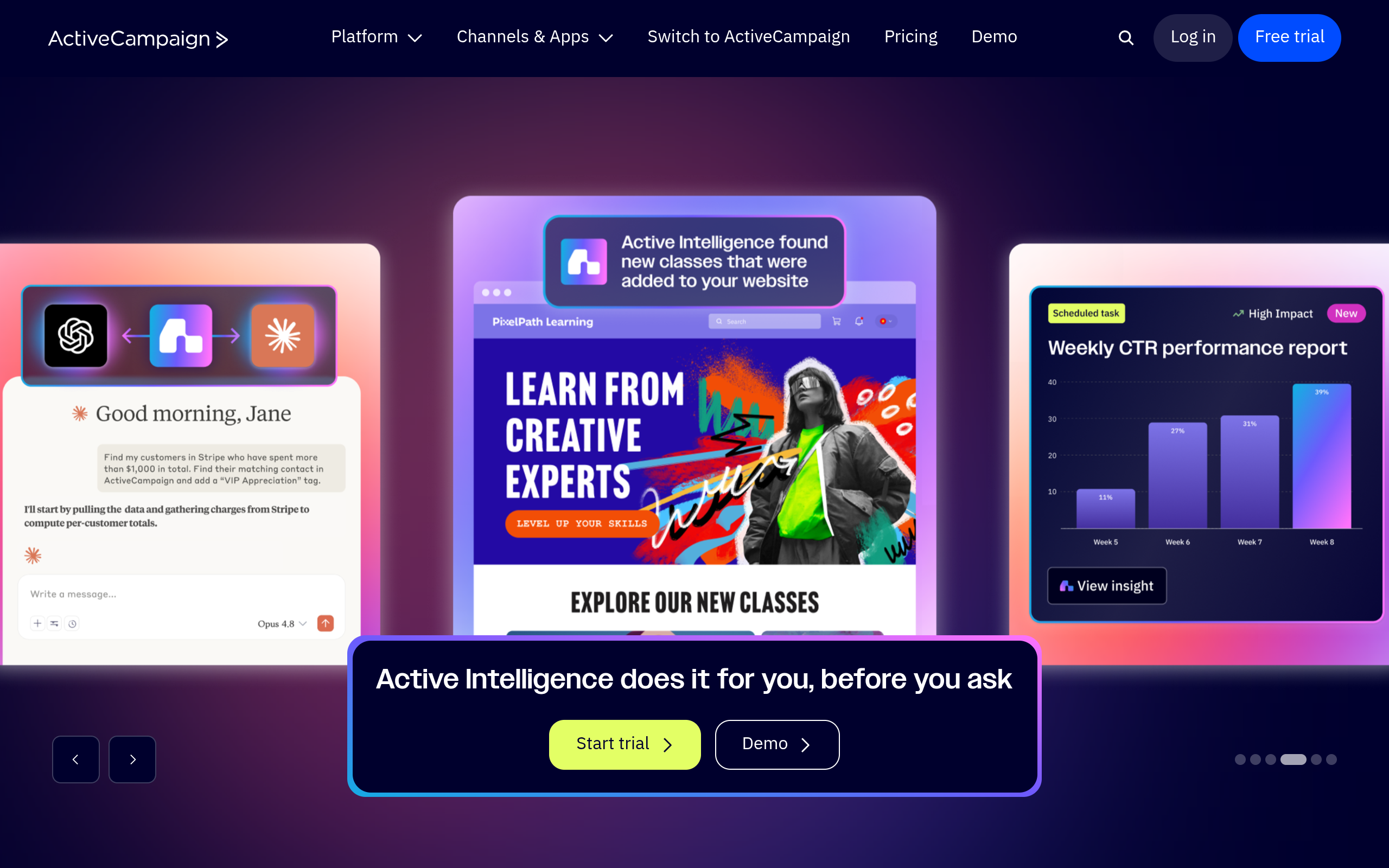
ActiveCampaign's homepage as of October 2026.
ActiveCampaign pairs email automation with an integrated sales CRM. The software lets teams build customer journeys shaped by behavioral logic and dynamic lead scoring.
Pricing runs on contact-based tiers. That means your monthly cost scales upward as your database grows.
For further reading, consult Email on Acid testing guides.
- Provides deep conditional automation paths and lead scoring rules.
- Includes a built-in sales CRM that syncs with marketing sequences.
- Offers advanced site tracking to trigger emails based on user browsing.
- Requires a steep learning curve for non-technical users.
- Carries higher monthly pricing than entry-level newsletter tools.
- Excludes phone support on lower-tier subscription packages.
Best for: Experienced B2B marketing teams that need detailed behavioral automations and CRM pipeline tracking.
Ready to launch your next email campaign?
Whichever platform you choose, Go4Database delivers verified B2B contact records to help you connect with qualified business buyers.
MailerLite
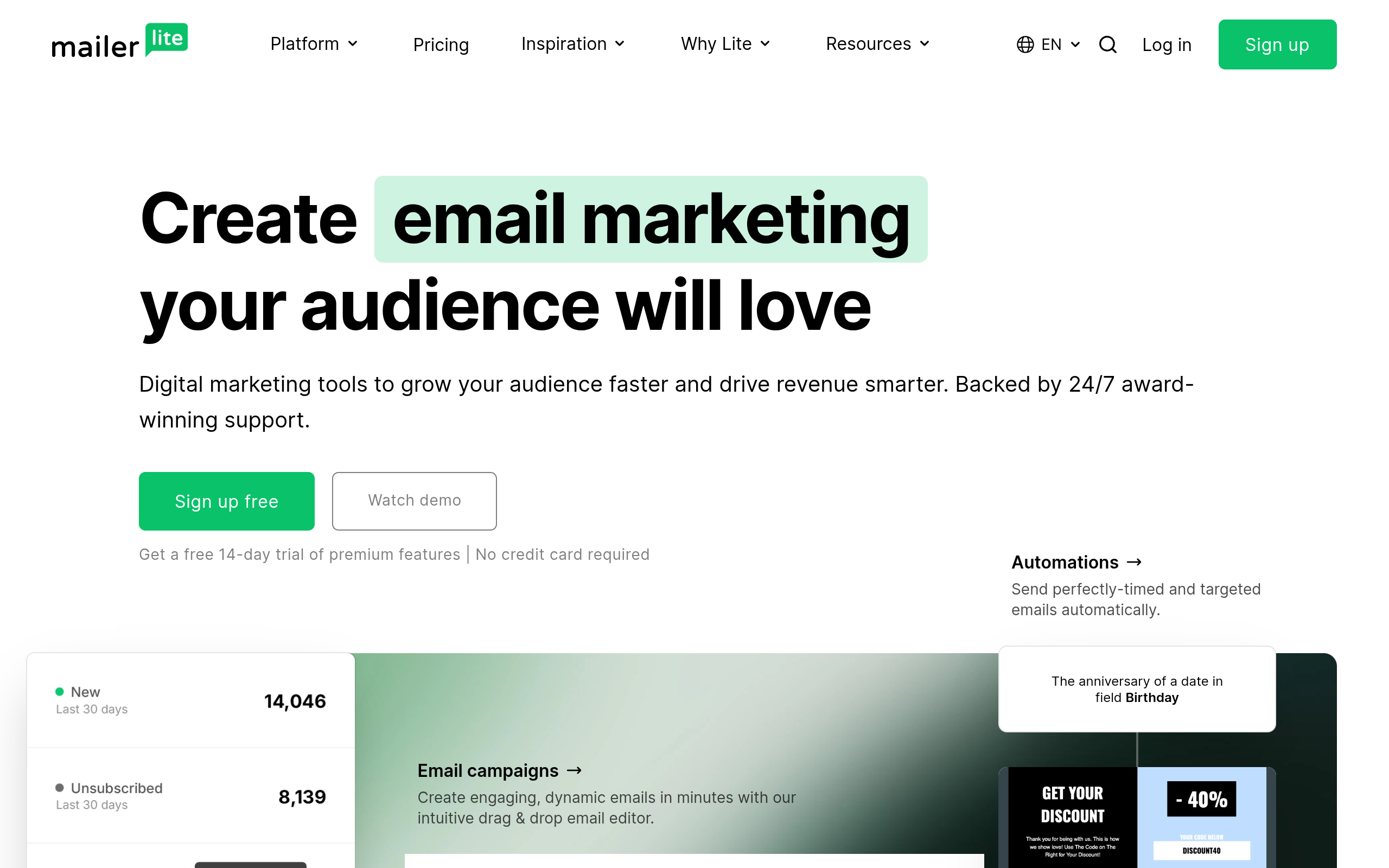
MailerLite's homepage as of October 2026.
MailerLite is an approachable email marketing service designed for small businesses, writers, and digital creators who want straightforward newsletter tools. It features a clean drag-and-drop visual builder, simple automation paths, and landing page creation.
The company charges by subscriber count, but it does not bill users for unsubscribed contacts.
- Maintains a very simple, clean user interface that beginners learn quickly.
- Does not charge account holders for unsubscribed or inactive profiles.
- Offers competitive, budget-friendly pricing tiers for small lists.
- Provides basic automation logic compared to enterprise systems.
- Includes fewer native integrations with complex enterprise databases.
- Enforces a strict account approval process before permitting live sends.
Best for: Independent creators and small businesses who need a simple, affordable way to send regular newsletters.
Instantly
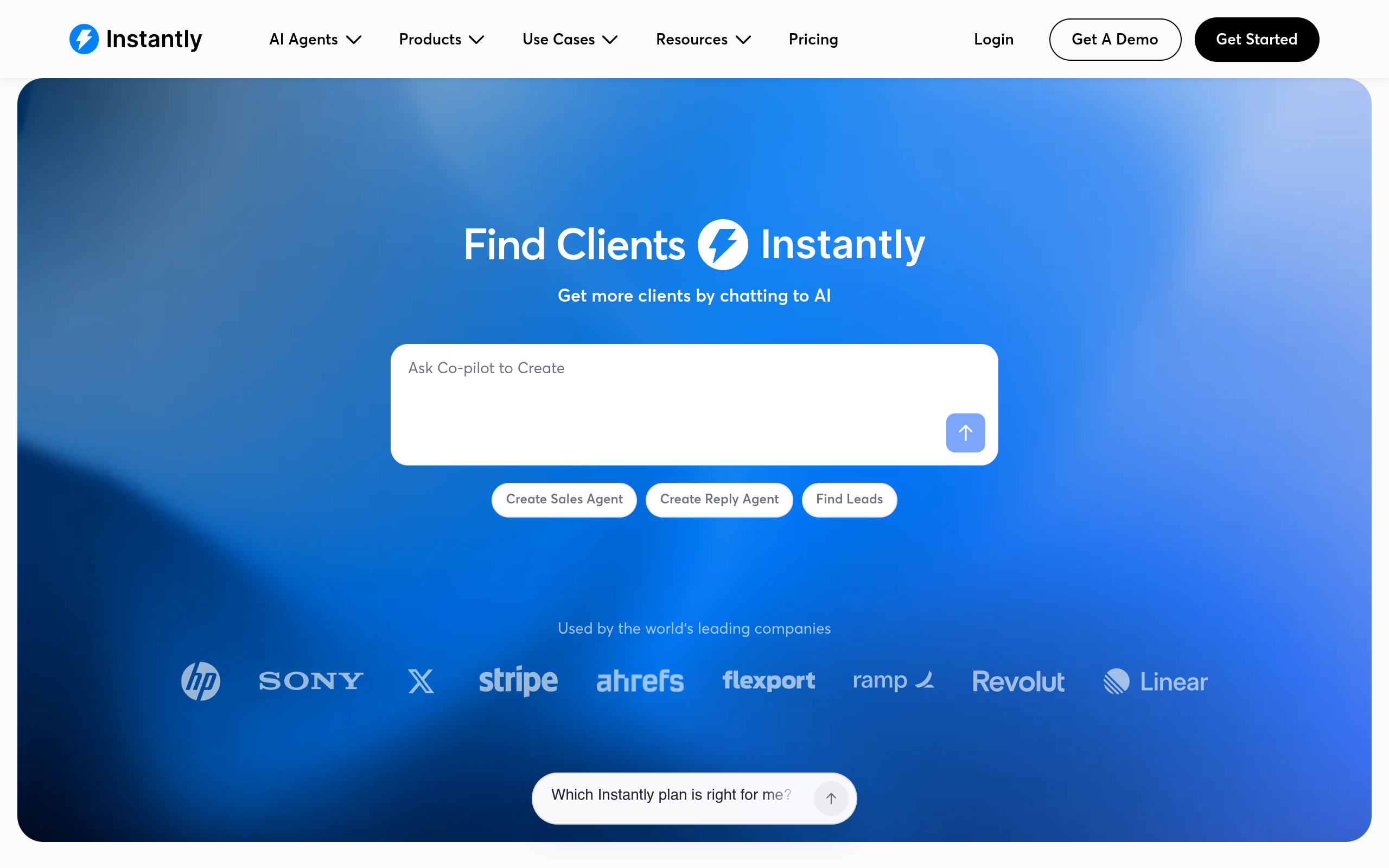
Instantly's homepage as of October 2026.
Instantly is an outbound sales engagement tool built for cold B2B email prospecting rather than inbound newsletters. It offers automated inbox warmup and lets sales reps connect multiple sending accounts to rotate deliverability loads.
The pricing reflects that outbound focus. It charges based on active outbound sending accounts and lead verification credits rather than subscriber storage.
- Designed particularly for cold outreach campaigns to prospective business leads.
- Includes automated mailbox warmup to establish domain reputation.
- Permits unlimited sender account connections on standard plans.
- Does not offer newsletter templates or inbound audience sign-up forms.
- Lacks e-commerce purchase tracking and abandoned cart automations.
- Requires users to supply their own outbound lead contact lists.
Best for: Outbound sales representatives and agencies running cold outreach campaigns with verified B2B contact data.
If you need specialized e-commerce features, exploring Mailchimp alternatives or reading a Klaviyo vs Mailchimp comparison will clarify your choices. Smaller teams can also review email marketing for small business options before making a long-term commitment.
TL;DR:
Brevo suits volume senders and technical teams, Mailchimp suits visual retail brands, and dedicated tools like Instantly handle outbound sales.
Final Decision Guide for Growing Teams
Migrating between email platforms rarely fixes stagnant conversion rates. If an audience is unengaged or the message misses the mark, switching software will not solve the underlying problem.
It helps to diagnose your lead flow before moving anything. Teams running cold outbound prospecting should always keep their outreach infrastructure separate from their opt-in newsletter tools.
Using verified prospect data from a provider like Go4Database helps sales reps reach relevant decision-makers directly. Once those contacts respond and engage, sync them into Brevo or Mailchimp to build the ongoing relationship.
Frequently asked questions
Can I upload a purchased email list to Brevo or Mailchimp?
Which platform is cheaper for small contact lists?
Does Mailchimp charge for unsubscribed contacts?
Can Brevo send transactional emails like order receipts?
Do Mailchimp and Brevo meet Gmail and Yahoo bulk sender rules?