On this page 6 sections
- 1. Mailchimp Review 2026: Features, Pricing, and Performance
- 2. Mailchimp Email Marketing Features: Automation, Templates, and Analytics
- 3. Mailchimp Pricing Plans: Are the Paid Features Worth It
- 4. Mailchimp Pros and Cons for Small Businesses and Marketers
- 5. Best Mailchimp Alternatives for Email Marketing in 2026
- The Verdict: Aligning Your Email Tool With Your Growth Strategy
You sign up for an email platform expecting steady pipeline growth. Months pass, your list expands slightly, yet software invoices double while reply rates stall.
Mailchimp reviews are user evaluations and expert assessments that examine the platform's pricing, features, usability, and deliverability. They matter because they help marketers evaluate automation workflows, template designs, and customer support quality before purchasing, ensuring teams choose a software solution that aligns with their campaign goals and budget.
Many marketing managers face this exact friction when evaluating their tech stack. Reading honest mailchimp reviews helps clarify whether an email service provider justifies its subscription costs against real inbox placement and list management rules.
At their core, Mailchimp Reviews reflect user feedback and expert evaluations analyzing the platform's pricing, features, and usability. They help buyers assess automation capabilities, deliverability rates, template designs, and customer support before committing.
When evaluating these software benchmarks, teams often balance inbound subscriber tools alongside outbound workflows. Many search verified contacts in go4database to fuel their direct sales pipeline.
Search habits have shifted significantly from early mailchimp reviews 2022 baselines toward stricter operational scrutiny today. Prospective buyers reading mixed mailchimp google reviews, critical mailchimp customer reviews, or eCommerce feedback in a mailchimp store reviews thread often seek practical facts.
Even when someone types an accidental chimpmail review query or searches for an overarching mailchimp website review, the core question remains the same. Buyers want to know what the platform handles well and where it falls short.
Mailchimp delivers polished visual templates for permission-based newsletters. However, sharp pricing tier increases and strict policies against third-party data make it costly for direct business prospecting.
1. Mailchimp Review 2026: Features, Pricing, and Performance
Evaluating Mailchimp requires balancing overall user satisfaction against actual inbox performance. On software review sites like G2 and Capterra, the platform earns solid ratings between 4.3 and 4.4 out of 5 stars.
Independent review sites tell a different story. On platforms like Trustpilot, scores hover near 2.5 out of 5, driven by surprise billing jumps and unexpected account suspensions (Mailsoftly Benchmark, 2026).
Deliverability also demands careful setup. Senders share server pools with thousands of unrelated accounts, which means poor sending habits from one company can directly affect everyone else on that cluster.
Protecting domain reputation requires custom authentication records: SPF to approve your sending servers, DKIM to verify message integrity, and DMARC to tell recipient servers how to handle unverified mail.
These safeguards matter because inbox standards are strict. Under the Google Workspace Admin Guide (2024), bulk senders must keep spam complaint rates below 0.10% and never touch 0.30%.
There is an important distinction here. Shared IP noise threatens inbox placement, but Mailchimp is built solely as an opt-in newsletter system, not a tool for outbound cold prospecting.
Pro tip: Always set up custom DKIM and SPF records in your DNS manager before sending campaigns to protect your domain reputation on shared IP addresses.
TL;DR:
While software directories highlight ease of use, reading critical mailchimp reviews reveals user frustration with pricing jumps. Pairing dedicated delivery tools with verified B2B lists from go4database produces far more predictable sales outcomes.
2. Mailchimp Email Marketing Features: Automation, Templates, and Analytics
Mailchimp relies on a drag-and-drop visual email editor. Recent updates also add Intuit Assist, an artificial intelligence tool designed to generate draft copy and subject variations (Intuit Mailchimp Product Release, 2025).
That visual builder works well for retail brands designing image-heavy campaigns. For direct business outreach, however, the underlying template code adds unnecessary overhead.
Automation options vary significantly by subscription tier. The Essentials tier omits multi-step branching workflows and send-time optimization (Venture Harbour, 2026). Growing teams must upgrade to the Standard tier to build custom lead-nurturing paths.
Reporting dashboards track open rates, click counts, and basic revenue numbers. In practice, automated privacy features in modern inboxes often trigger artificial opens. Website actions and downstream CRM pipeline stages remain the most dependable success indicators.
Is Mailchimp Good for Cold Email and Outbound Prospecting
Loading unverified prospect files into Mailchimp creates immediate compliance problems. Section 3 of the Mailchimp Acceptable Use Policy (2025) explicitly prohibits purchased, scraped, or third-party email lists.
To enforce this, Mailchimp runs an automated system named Omnivore. It monitors list uploads and quickly freezes accounts showing high bounce indicators.
Outbound teams need dedicated sales engagement tools connected to authenticated mailboxes. Reserve Mailchimp exclusively for subscribers who joined voluntarily through your landing pages or website signups.

Power Your Automation With Quality Data
Fuel your automated campaigns by acquiring verified B2B contact records from Go4Database to maximize inbox placement.
3. Mailchimp Pricing Plans: Are the Paid Features Worth It
Mailchimp bases its billing on total contact storage rather than send volume alone. The Free plan limits accounts to 250 contacts and 500 total sends per month, with a daily cap of 250 emails (Activepieces, 2026).
A major hidden cost involves unengaged records. Under the official Mailchimp Pricing Policy (2026), accounts pay for subscribed, non-subscribed, and unsubscribed contacts alike until you manually archive them.
Businesses regularly pay monthly fees for people who opted out months ago. Tier costs jump rapidly as your audience expands.
On the Standard plan, monthly pricing starts at $20 for 500 contacts, reaches $100 for 5,000 contacts, and hits $135 for 10,000 contacts (Activepieces, 2026).
Legacy accounts created before May 2019 saw an 11% to 13% price increase in April 2026 (Retainful, 2026). Live phone support remains exclusive to the Premium tier, starting at $350 per month (Dreamlit AI, 2026).
| Plan Tier | Entry Monthly Cost | Contact Allowance | Key Feature Access | Support Availability |
|---|---|---|---|---|
| Free Plan | $0 | 250 contacts / 500 sends | Basic forms, pre-built templates, 1 audience | Email support (first 30 days) |
| Essentials | $13/mo (starts at 500) | Scales by contact count | Basic A/B testing, single-step automation | 24/7 Email and Chat |
| Standard | $20/mo (starts at 500) | $100/mo at 5k; $135/mo at 10k | Branching customer journeys, Intuit Assist AI | 24/7 Email and Chat |
| Premium | $350/mo (starts at 10k) | Scales past 10,000+ contacts | Advanced segmentation, multivariate testing | Phone and Priority Chat |
How to Build Predictable B2B Pipeline Without Overpaying for Contacts
Relying solely on inbound forms can leave your sales calendar empty. Steady pipeline requires a more direct approach.
Instead of paying escalating monthly software storage fees, you can target specific accounts directly. With go4database contact plans, teams get direct records for key decision-makers.
Within go4database, you can find verified mobile numbers and work profiles across thousands of industries. That lets you download accurate records and feed dedicated sales outreach systems at predictable flat rates.
Pro tip: Regularly archive unsubscribed contacts inside Mailchimp at the end of each billing cycle to prevent crossing into higher pricing brackets.
TL;DR:
Mailchimp bills you for inactive and unsubscribed records. Teams can lower overall acquisition overhead by sourcing verified business audiences through go4database and running them through focused outreach platforms.
4. Mailchimp Pros and Cons for Small Businesses and Marketers
For online stores, Mailchimp offers clear practical benefits. It connects directly with platforms like Shopify, WooCommerce, and standard CRMs. Its templates help non-designers produce clean newsletters quickly, backed by dependable application uptime and straightforward audience segmentation options.
Growing teams often face real friction. Strict Omnivore monitoring penalizes non-permissioned audience imports, while contact-based billing structures inflate recurring monthly software costs.
Support options are also limited. According to the official Mailchimp Pricing Policy (2026), phone support is restricted to accounts paying around $350 monthly on premium tiers. Lower tiers must rely entirely on email and chat queues.
Scale Your Outreach Without Wasted Spend
Avoid paying for duplicate or invalid leads with accurate B2B contact lists curated by Go4Database.
Who Should Actually Pay for Mailchimp
Mailchimp works well for online retail stores needing native abandoned-cart triggers. It also suits local companies collecting emails at the point of sale and independent publishers sending editorial newsletters.
B2B founders, agencies, and outbound sales reps should look elsewhere. Cold prospecting requires specialized email delivery systems designed for individual conversation building.
5. Best Mailchimp Alternatives for Email Marketing in 2026
If Mailchimp no longer fits your operational budget or feature requirements, several competitors offer distinct advantages. Here is an analysis of top platforms providing stronger automation, creator tools, and flexible pricing.
Brevo
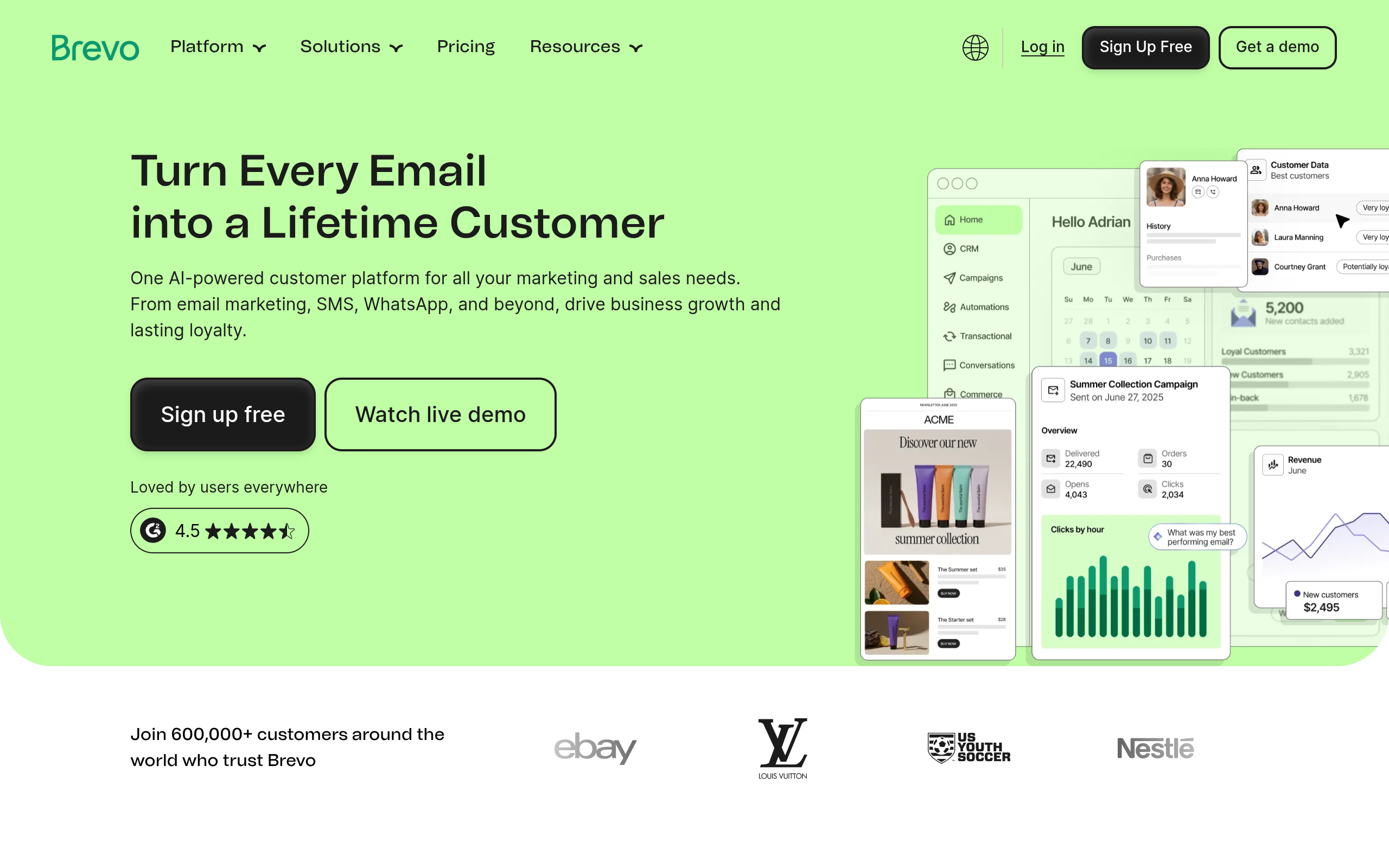
Brevo's homepage as of October 2026.
Brevo handles marketing campaigns, transactional receipts, and SMS from one dashboard. Rather than billing by subscriber count, it prices plans on how many emails you send each month.
Every tier includes unlimited contact storage, which helps if your list is large but you send irregularly. The free plan allows 300 emails per day without contact limits.
That 300-send daily cap makes standard marketing blasts difficult on the free plan, and complex automation requires higher tiers. It suits growing stores that want costs tied strictly to send volume.
ActiveCampaign
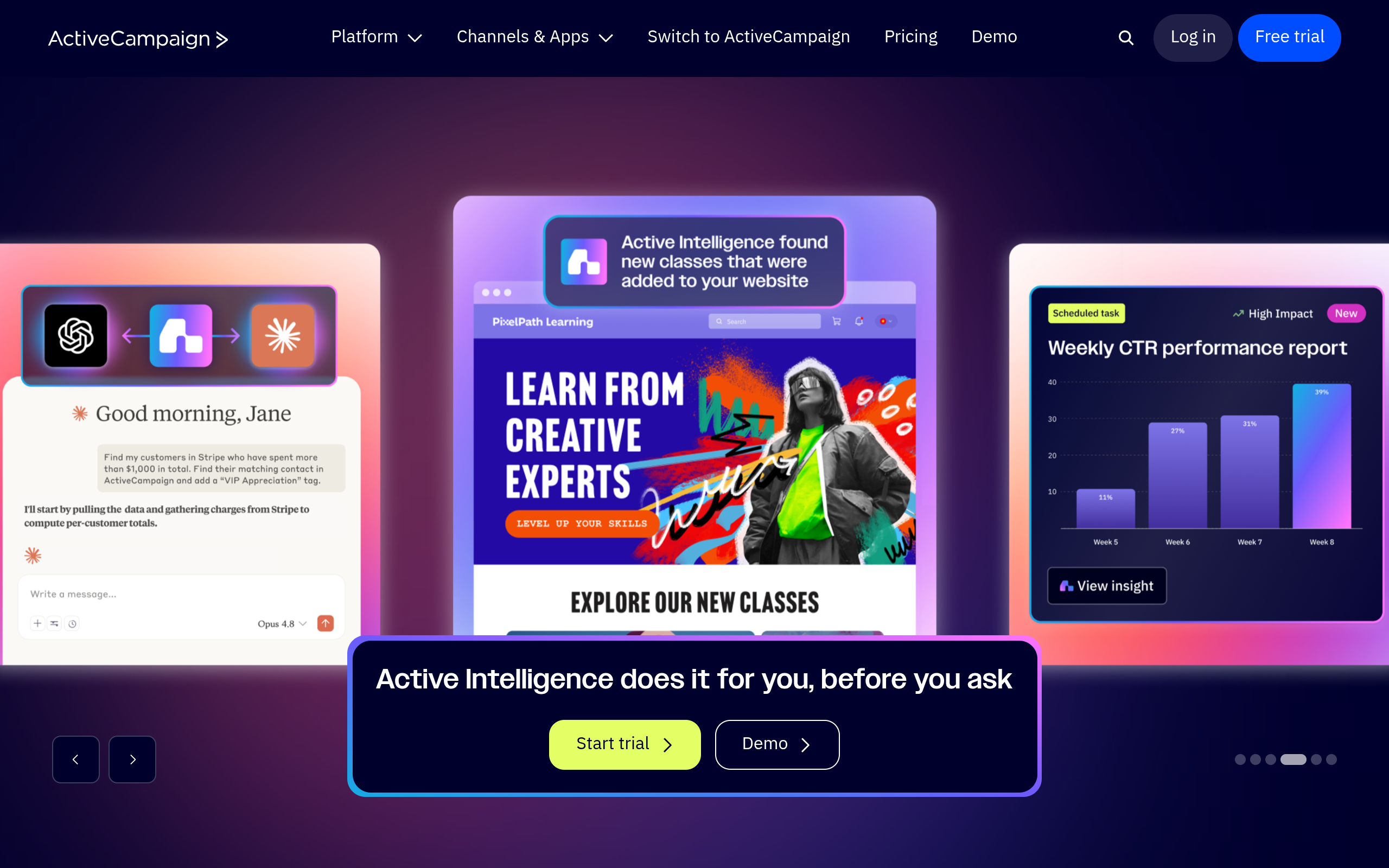
ActiveCampaign's homepage as of October 2026.
ActiveCampaign pairs a multi-branch automation builder with an integrated sales CRM. Technical teams can use conditional filters to trigger campaigns from visitor behavior and link messages directly to deal stages.
Setting up the system takes real onboarding time, and costs climb steeply as your audience expands. It suits B2B companies requiring complex lead nurturing journeys connected directly to active sales pipelines.
Reach Decision Makers on Any Platform
Connect your chosen email platform with verified decision maker emails and phone numbers from Go4Database.
ConvertKit (Kit)
ConvertKit's homepage as of October 2026.
ConvertKit, now branded as Kit, is built mainly for solo creators, authors, and consultants. Instead of heavy visual templates, it prioritizes clean, text-centric emails.
That lighter formatting supports reliable inbox delivery. Creators can organize subscribers with flexible tags and use an organic creator network for referrals.
There is a clear tradeoff here. Kit offers simpler visual tools for retail brands and more basic analytics than enterprise platforms. It remains best for writers and consultants who focus on deliverability.
The Verdict: Aligning Your Email Tool With Your Growth Strategy
Choosing the right tool comes down to your acquisition model. Inbound platforms like Mailchimp, Brevo, or Kit work best for warm audiences who joined your community voluntarily.
For outbound demand generation, never risk your primary marketing domain or marketing automation accounts. A better path is to download accurate decision-maker data through go4database and route cold conversations through specialized outreach platforms.
Frequently asked questions
Does Mailchimp offer a completely free plan?
Can I upload purchased B2B email lists to Mailchimp?
Does Mailchimp charge you for unsubscribed contacts?
Is Brevo cheaper than Mailchimp for small businesses?
What is the minimum plan to get Mailchimp phone support?