On this page 6 sections
- Best Email Marketing Platforms Compared in 2026
- Key Features to Look for in Email Marketing Software
- Email Marketing Platforms for Small Businesses and SaaS Companies
- Email Marketing Pricing, Automation, and Deliverability Compared
- How to Choose the Right Email Marketing Platform for Your Business
- Final Decision Guide for Modern Email Stacks
You can spend weeks designing responsive layouts, refining product copy, and polishing marketing offers. Yet none of that work matters if your messages land quietly in junk folders.
Selecting the right sending infrastructure has become a complex operational hurdle.
Teams often sign up for popular software expecting an all-in-one distribution engine, only to face unexpected contact limits and policy suspensions.
In simple terms, an Email Marketing Platform helps businesses create, automate, and track messages sent to subscriber lists. Comparing options in 2026 means evaluating core features like deliverability, workflow automation, and analytics to support your outreach.
At a technical level, an email marketing provides dedicated sending infrastructure. It helps teams schedule, automate, and monitor commercial campaigns directed at clearly segmented audiences.
Modern growth teams use an email marketing platform to nurture permission-based subscribers.
At the same time, many rely on verified sales intelligence databases like Go4Database to source and validate target business records before launching outreach.
The core challenge stems from a fundamental industry divide. Tools built for permission-based newsletters enforce completely different technical standards than platforms built for outbound sales.
If you mix up those operational boundaries, your domain reputation will likely suffer.
Reach More Buyers with Verified Emails
Find verified business contacts to expand your email marketing reach and connect with decision-makers.
Best Email Marketing Platforms Compared in 2026
Navigating commercial software in September 2026 requires looking past surface-level visual builders. Major mailbox providers now enforce rigorous authentication standards that penalize misconfigured domains and unverified sending practices.
Traditional tools rely on shared IP pools designed exclusively for opt-in subscribers.
In contrast, modern sales systems connect directly to individual mailboxes to handle direct B2B conversations.
Understanding this boundary is the first step in finding the best the two platforms for your specific business model.
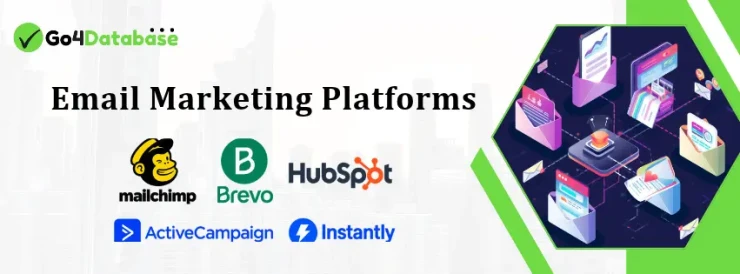
Let us review the six major platforms leading the market today, examining how each system handles list policies, pricing structures, and daily delivery.
1. Mailchimp

Mailchimp's homepage as of September 2026.
Mailchimp is an Intuit-owned marketing platform designed primarily for small businesses, creative agencies, and ecommerce stores.
It centers on visual email design, brand building, and basic multi-channel email marketing campaigns.
The interface is familiar and includes a broad library of newsletter templates. It connects directly to major storefronts, making it practical for teams without technical web developers.
Businesses comparing free email marketing tools should review contact limits, monthly sending allowances, and available automation features before choosing a platform.
According to the Mailchimp Acceptable Use Policy, the platform strictly prohibits third-party, purchased, or scraped B2B contact lists.
Its free tier also remains restricted to 250 contacts and 500 monthly sends as of 2026 pricing documentation.
Mailchimp also charges recurring fees for unsubscribed and inactive contacts left in your audience lists. In practice, it works best for small consumer brands and creators communicating solely with direct, opted-in subscribers.
2. Brevo

Brevo's homepage as of September 2026.
Brevo handles email marketing, transactional messaging, SMS, and WhatsApp campaigns. It is designed for businesses that prefer paying for monthly send volume rather than total database size.
Teams frequently choose this email platform to manage automated order receipts alongside weekly brand newsletters.
The free plan provides up to 300 emails per day without upfront payment.
Keep in mind that late 2025 pricing updates capped entry-level Starter tiers at 500 stored contacts. Brevo also strictly bans cold outreach and unverified third-party B2B contact data.
Removing the platform branding footer requires an added monthly fee on lower tiers.
Brevo remains well suited for lean teams prioritizing transactional notifications and opt-in newsletters on a flexible send budget.
3. HubSpot Marketing Hub

HubSpot Marketing Hub's homepage as of September 2026.
HubSpot Marketing Hub focuses on inbound marketing and lead nurturing, built directly into HubSpot's CRM.
It helps growth-stage companies coordinate content marketing, form captures, and multi-touch lead scoring workflows.
The software synchronizes contact activity across marketing pipelines, sales pipelines, and customer support desks in real time. It pairs practical automation logic with reporting that connects campaigns directly to closed revenue.
The platform involves a steep price jump from Starter to Professional tiers, often costing hundreds of dollars monthly alongside mandatory onboarding fees.
Acceptable use rules also forbid external lead databases, cold B2B lists, and non-opt-in prospect imports.
HubSpot also charges rising incremental fees as marketing contact tiers expand over time. It is best for mid-market companies with established inbound lead capture engines and dedicated CRM budgets.
4. ActiveCampaign

ActiveCampaign's homepage as of September 2026.
ActiveCampaign blends email marketing, automated conditional messaging, and sales pipeline management.
It works best for teams that rely on visual workflow logic, site tracking triggers, and detailed engagement tracking.
Teams can split-test entire automation paths, adjusting delays and message branches based on user actions.
Deliverability remains strong, provided your list is verified and strictly permission-based.
Watch the billing details, though. Under terms documented in late 2025, ActiveCampaign counts all held records, including bounced and unsubscribed contacts, toward plan limits. It offers no permanent free plan beyond a 14-day trial.
Because the platform rigidly enforces opt-in verification, cold outbound B2B prospect lists are banned. It fits SaaS companies running intricate, behavior-based nurturing sequences for qualified inbound leads.
5. Instantly

Instantly homepage as of September 2026.
Instantly is a cold email platform built particularly for outbound B2B sales and prospecting. Rather than sending through shared marketing servers, it connects directly to secondary business email accounts.
A unified inbox lets reps manage replies across dozens of connected mailboxes in one central feed.
The flat-rate pricing supports high send volumes without charging penalties for storing contacts.
You will not find visual newsletter builders or ecommerce templates here. The setup also requires buying secondary domains and separate inboxes, without providing inbound website tracking or form builders.
Instantly works best for sales agencies and B2B founders looking to build pipeline from targeted prospect lists.
Build Your Pipeline with Targeted B2B Leads
Discover targeted B2B contacts to support outreach campaigns and drive business growth.
Key Features to Look for in Email Marketing Software
Choosing between different email marketing software options requires evaluating AI email marketing features, technical deliverability safeguards, and automation capabilities.
Strong email deliverability helps businesses reach subscribers' inboxes, reduce bounce rates, and improve campaign performance.
Mailbox providers have tightened technical enforcement significantly over the past two years. Under the Google Sender Guidelines and the Yahoo Sender Hub, senders delivering over 5,000 emails daily must implement SPF, DKIM, and DMARC authentication.
Those standards establish a strict 0.3% maximum spam complaint ceiling, while recommending rates stay below 0.10%. Senders must also comply with basic commercial rules outlined in the FTC CAN-SPAM Guide.
The Microsoft Sender Guidelines take a similar approach. Microsoft enforces SPF, DKIM, and DMARC authentication alongside the same 0.3% complaint threshold across Outlook and Exchange environments.
Late 2025 Google Postmaster updates confirmed that penalties for non-compliance have escalated. Unaligned messages from bulk senders now face permanent rejections rather than temporary SMTP deferrals.
Your software must support SPF to verify which sending servers are authorized for your domain. It must also align with DKIM, which uses a cryptographic signature to prove messages were not altered in transit.
Your domain also needs DMARC. This policy instructs receiving mail servers how to handle any messages that fail SPF or DKIM checks.
Commercial tools must also support RFC 8058, which puts a one-click unsubscribe button directly in the inbox header. Yahoo and Google require bulk senders to process opt-out requests within 48 hours.
Pro tip: Set up a custom tracking domain using your own CNAME record to replace your software vendor's default tracking links, which prevents shared domain filters from misclassifying your emails.
Tracking engagement has changed significantly.
Benchmark reports from MailerLite show open rates hovering at 42.35%, largely driven by Apple Mail Privacy Protection machine pre-fetching. Meanwhile, real click-through rates averaged between 1.4% and 2.62%.
Because security filters automatically open incoming emails to scan links, raw open rates no longer reflect human attention.
Modern teams measure deliverability through click-through rates, direct replies, and conversion metrics instead.
List hygiene remains your primary line of defense. Deliverability studies by ActiveCampaign (2025-2026) report average bounce rates ranging from 2.33% to 10.4%.
Mailbox providers actively penalize sending domains exceeding a 2% hard bounce threshold.
A hard bounce happens when an email permanently fails because the destination address does not exist. That failure damages sender reputation, so outbound teams protect their technical standing by validating records ahead of time.
According to its site, Go4Database lists more than 400 million business contacts and 130 million direct mobile numbers across 9,000 industries. That catalog allows operators to filter for verified records and suppress invalid accounts before loading data into sending tools.
Email Marketing Platforms for Small Businesses and SaaS Companies
A common mistake is treating inbound lead nurturing and outbound prospecting as the same job.
They require completely different technical stacks, sending configurations, and compliance rules.
Small businesses, local agencies, and ecommerce stores usually thrive on permission-based email. In this model, prospects opt in through website forms, content downloads, or transactional checkouts.
Platforms like Mailchimp, Brevo, and ActiveCampaign excel at this work.
They offer visual editors, automated cart triggers, and preference centers where engagement rates stay relatively predictable.
Early-stage SaaS teams and B2B service firms need effective B2B email marketing strategies to generate qualified leads and sustain growth, making direct outreach necessary.
Running cold campaigns requires a dedicated cold email platform like Instantly or Apollo.
These tools focus on plain-text messages, randomized delays, and multi-inbox rotation.
Multi-inbox rotation distributes your daily volume across several independent accounts.
That split prevents any single mailbox from exceeding safe sending thresholds.
Major sales platforms have also phased out automated peer-to-peer warmup pools following provider crackdowns. Reliable delivery now relies on gradual volume increases and genuine human replies.
Vendor policies introduce another critical distinction. If you upload an external B2B database into traditional tools like Mailchimp or HubSpot, you risk account suspension.
These platforms protect their shared IP reputations aggressively. If an uploaded list triggers spam complaints or hard bounces, the provider will quickly suspend sending privileges.
Pro tip: Keep your primary company domain dedicated entirely to operational business email and opt-in newsletters, while hosting all outbound sales campaigns on secondary domains that redirect to your main site.
Finding the best email platform for small business growth starts with your contact source. Use inbound software for people who signed up on your site, and keep outbound tools on secondary domains for direct outreach.
Email Marketing Pricing, Automation, and Deliverability Compared
Understanding the true cost of an email platform comes down to billing mechanics. Advertised starting prices often hide steep scaling tiers, contact storage fees, and mandatory add-ons.
Across the six featured platforms as of 2026, pricing models, storage limits, and permitted list sources differ significantly.
Those mechanics determine what you actually pay as your list grows.
| Platform | Primary Pricing Model | Entry Published Price (2026) | Contact Limits and Overage Mechanics | Permitted List Source Policy | Sending Infrastructure |
| Mailchimp | Contact-tiered subscription | $13/mo (500 contacts, Essentials) | Counts subscribed, unsubscribed, and non-subscribed contacts toward billing caps | Strictly opt-in only; bans purchased, scraped, or third-party B2B lists | Shared IP pools (dedicated IPs reserved for high-volume custom plans) |
| Brevo | Send-volume tiered with contact caps | $9/mo (5,000 sends/mo, Starter) | Starter capped at 500 contacts; scales cost as monthly send allotments expand | Strictly opt-in only; prohibits cold lists, acquired data, and scraped contacts | Shared IP relays with optional dedicated IP add-on |
| HubSpot Marketing Hub | Seat and marketing contact hybrid | $15-$20/seat/mo (Starter, 1,000 contacts) | Professional jumps to $800+/mo with mandatory $3,000 onboarding; steep contact scaling fees | Strict permission-based opt-in; bans third-party and non-opt-in prospect data | Enterprise shared IP pools or dedicated IP add-on for high tiers |
| ActiveCampaign | Contact-tiered subscription | $15/mo billed annually (1,000 contacts, Starter) | All stored records count toward billing tiers, including bounces and unsubscribes | Explicit permission-based opt-in required; bans cold and third-party lists | Shared sender infrastructure optimized for opt-in behavioral triggers |
| Instantly | Flat email volume and sending accounts | $47/mo (1,000 contacts, 5,000 sends/mo) | Unlimited connected inboxes; costs scale with email volume tiers and lead add-ons | Designed for cold B2B outreach; allows verified third-party list imports | Individual business inboxes (Google Workspace, M365, private SMTP) |
A common trap in contact-metered platforms is the unsubscribed contact tax. Mailchimp counts every stored record toward your monthly bill, whether that person can legally receive your emails or not.
According to late 2025 ActiveCampaign documentation, new signups also pay for all held contacts against tier limits, including unsubscribed, bounced, and unconfirmed records.
Without regular cleaning, software costs climb while your active audience shrinks.
Send-volume pricing provides a helpful alternative for certain business models. Brevo instituted contact storage caps on lower-tier plans, restricting Starter accounts to 500 stored contacts at entry volume as of late 2025.
On higher tiers, paying for total sends can still benefit businesses with large seasonal lists. Understanding how your list expands will prevent expensive billing surprises.
Automation capabilities also vary significantly.
ActiveCampaign and HubSpot provide visual journey builders that branch contacts based on page visits, purchase history, and lead scoring thresholds.
These complex automations work well for nurturing qualified inbound leads through long buying cycles.
Outbound prospecting, however, demands a much simpler technical setup.
If you are sending cold B2B messages, heavy visual designs and tracking pixels can harm inbox placement. Plain-text messages with minimal links reach the inbox far more reliably.
Traditional marketing suites bill on total stored records, while cold platforms scale on monthly send volumes. Teams often pair verified prospect data from third-party databases with flat-rate outbound software to avoid compounding markups.
For example,
Go4Database states it offers plans starting at $0 for a free trial or $59 per month for Micro Active. That setup gives teams access to verified B2B records without per-contact storage penalties.
Launch Smarter Campaigns with Better Data
Access business contact data to build focused email campaigns and reach relevant prospects.
How to Choose the Right Email Marketing Platform for Your Business
Choosing the best email platform comes down to evaluating your contact source, technical needs, and monthly budget. Most importantly, you need an infrastructure that protects your core business domain.
Modern operations work best with separate domains. Your everyday workspace and company newsletters should run on your primary domain through an opt-in platform like Brevo or ActiveCampaign.
If you run outbound sales campaigns, configure secondary sending domains instead. These redirect visitors to your primary website while isolating prospecting on separate email accounts. If a cold sequence triggers high spam complaints, your primary domain remains unaffected.
Follow this diagnostic framework to choose your software stack:
1. Identify your list origin: If contacts opted in through your website, choose an inbound suite. If reaching out to cold prospects, use a dedicated sales engagement platform.
2. Audit total storage costs: Review how each vendor charges for unengaged, bounced, and unsubscribed contacts over a 12-month period to avoid unexpected fees.
3. Verify DNS setup: Ensure your team can correctly publish SPF, DKIM, DMARC, and custom CNAME tracking records before sending any commercial broadcasts.
4. Clean your recipient data: Validate contact records through trusted verification tools prior to campaign launch, confirming that projected bounce rates remain below the 2% limit noted by ActiveCampaign research (2025-2026).
Final Decision Guide for Modern Email Stacks
Choosing an email platform comes down to how you acquire customers. If your business runs on inbound content and subscriber onboarding,
An inbound suite like ActiveCampaign or Brevo provides email marketing services, transactional messaging, SMS, and WhatsApp campaigns for businesses managing customer communications.
Forcing cold prospect lists through those systems will only lead to deliverability problems and account terminations.
If your immediate goal is generating new B2B sales conversations, set up a dedicated outbound platform like Instantly on secondary domains.
Pair that sending setup with clean, pre-verified contact data from trusted sources like Go4Database. When your software matches your acquisition strategy, you protect your sender reputation and achieve sustainable campaign growth.
Frequently asked questions
Can I upload a purchased B2B contact list into Mailchimp?
What is the maximum safe email bounce rate in 2026?
Why do marketing platforms charge for unsubscribed contacts?
Do I need a separate domain for cold email outreach?
What spam complaint rate triggers domain filtering by Google and Yahoo?