
On this page 6 sections
You can spend hundreds of dollars each month on subscriptions and still stare at an empty sales pipeline. If you are shopping for software, you need a system that reliably turns conversations into closed transactions.
In practice, software only organizes the opportunities you actively create. Productive agents do not rely on an empty database. Instead, they connect their system with verified property owner and investor data from our team at Go4Database. The real question is not which vendor offers the longest feature list. A bloated platform usually creates more administrative work than it solves.
What is the best CRM software for real estate is the platform that matches your team's daily workflow while offering automated follow ups, MLS integration, and pipeline tracking. This choice matters because the right platform helps agents manage prospects efficiently and close more deals without creating unnecessary administrative work.
Instead, look at the fundamentals. You need a tool that captures inbound inquiries instantly, protects your sender reputation, and supports outbound prospecting without trapping your agency in rigid contracts.
Why Real Estate Agents Need Specialized CRM Software
Generic sales software works well for standard corporate accounts, but it breaks down under residential property workflows.
Most general tools simply do not understand closing milestones, escrow contingencies, or property listing data feeds.
A recent industry study from Ascendix Technologies found that only 32% of real estate firms use a dedicated property CRM. The remaining 68% still juggle client records across spreadsheets, paper notepads, and scattered inbox threads.
Manual tracking creates response delays that directly hurt conversions. In a study shared by SelectHub, reps contacting prospects within 5 minutes were 21 times more likely to qualify them than those waiting 30 minutes.
Property timelines also stretch far longer than typical sales cycles. Research published by the National Association of Realtors indicates that online residential inquiries typically spend 12 to 18 months researching before closing.
According to the National Association of Realtors, agents using automated follow-up software can see more than double the conversion rate of manual tracking. They also generate substantially more repeat transactions from their sphere of influence.
What is the best crm system for real estate when managing lead response times
When lead response speed is the priority, the best real estate CRM centers on instant connection. Dedicated platforms use automated call bridging and rapid text autoresponders to reach buyers within seconds of an inquiry.
The moment an online form arrives, the system dials your phone and bridges the call directly to the buyer. That fast handoff keeps prospects from calling competing brokers while their interest remains high.
Fast routing only works when the underlying contact data is clean. Teams that pair rapid routing with verified records from our real estate industry list maintain steady deal volume across changing market conditions.
TL;DR:
Specialized property CRMs solve two problems that generic tools cannot: they guarantee five-minute response speeds for new inquiries and automate nurturing across multi-month closing cycles.
Pro tip: Set up a direct phone-bridge rule inside your CRM so incoming portal inquiries ring your mobile phone within thirty seconds.
Top 5 Best Real Estate CRM Platforms Compared
Choosing the right platform often comes down to how the software is built. Some vendors bundle your consumer website and contact records into a single closed suite, making migrations difficult.
Other platforms use an open architecture. They let you connect independent websites, custom databases, and outside prospecting tools, but each model comes with clear tradeoffs.
| Platform | Starting Price | Architecture Model | Key Strengths | Core Limitations | Best For |
|---|---|---|---|---|---|
| Follow Up Boss | $69/user/month | Open Architecture (250+ APIs) | Lead routing, call logging, deep integrations | No native IDX website builder | High-producing teams and outbound pros |
| Lofty | $400 to $500/month | Closed All-in-One Suite | Built-in AI assistant, dynamic IDX sites | High starting cost, steep learning curve | Established teams wanting one complete suite |
| BoldTrail | Tiered broker pricing | Enterprise Ecosystem | Back-office transaction sync, recruiting | Complex interface, rigid templates | Large multi-office brokerages |
| Wise Agent | $49/month (up to 5 users) | Lightweight Hub | Transaction management, shared team calendars | Older interface, basic pipeline reports | Solo agents and budget-conscious teams |
| LionDesk | $39/month | Communications Hub | Integrated video texting, built-in power dialer | Basic pipeline views, limited scaling | Individual agents focused on video outreach |
Follow Up Boss
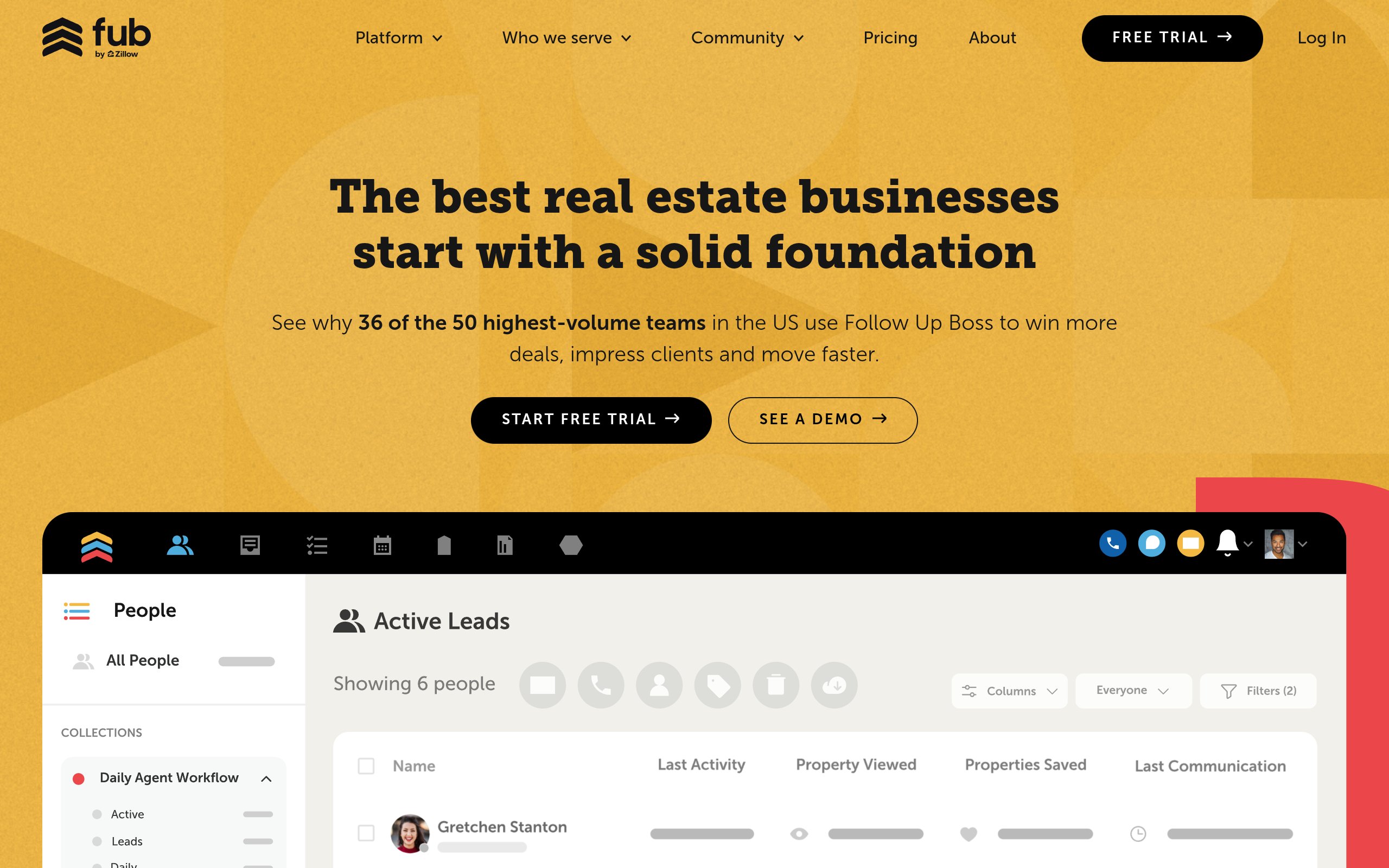
Follow Up Boss's homepage as of November 2026.
Follow Up Boss acts as a central hub for high-volume sales teams. It pulls in inquiries from over 250 third-party lead sources without locking your business into a proprietary website system.
The platform handles call recording, text logging, and fast lead distribution to available agents. Because it uses an open API, your team can easily import external prospecting lists and connect other marketing tools.
The main limitation is that it lacks an integrated property search site, requiring a separate website subscription. It is now owned by Zillow, so teams should review data terms carefully.
Best for: Productive sales teams and independent outbound agents who want full control over their operational data.

Populate Your Top Real Estate CRM Platform
Power your newly chosen CRM platform with verified property owner contacts from Go4Database today.
Lofty

Lofty's homepage as of November 2026.
Formerly known as Chime, Lofty is highlighted by AgentAdvice for pairing property search sites with automated follow-up. It brings web traffic, paid ads, and lead messages into a single dashboard.
Its real strength is behavioral tracking. The platform sends automated text messages when past visitors return to browse listings, and the mobile app simplifies checking in guests during weekend open houses.
The catch is vendor lock-in and steep monthly overhead. If you ever cancel your account, you lose both your public search website and your past search records completely.
Best for: Mid-sized teams seeking an all-in-one inbound marketing and nurturing platform.
BoldTrail

BoldTrail's homepage as of November 2026.
Inside Real Estate developed BoldTrail as the upgrade to kvCORE. The software combines front-office lead routing, back-office accounting, and multi-office agent recruiting into a single system.
It syncs property listings, generates local market reports, and keeps closing checklists inside each contact file. These tools give franchise leaders clear operational oversight across multiple locations.
The interface is quite complex, which often lowers daily adoption among field agents. It is also sold through brokerage enterprise agreements rather than flexible month-to-month individual accounts.
Best for: Large enterprise brokerages requiring centralized operational oversight across several branch offices.
Housing Wire

Wise Agent's homepage as of November 2026.
HousingWire notes that Wise Agent offers an accessible CRM choice for boutique firms and independent agents. It packages transaction checklists, contact organization, and document storage without high monthly software costs.
One clear advantage is predictable pricing, which includes up to five team user accounts on its standard tier. It also connects smoothly with everyday business tools like Google Workspace and DocuSign.
The tradeoff is the interface, which looks somewhat dated compared to modern web apps. It also lacks an integrated power dialer for outbound prospecting, and complex multi-channel drip automation remains limited.
Best for: Solo agents, small partnerships, and residential brokerage firms seeking practical transaction tracking on a modest budget.
LionDesk
LionDesk's homepage as of November 2026.
LionDesk focuses on direct communication rather than complex transaction management. It gives agents practical tools to record quick video messages, make phone calls, and send automated text sequences.
Video messages help agents stand out in crowded buyer inboxes, while the built-in dialer speeds up prospecting calls. The interface stays simple enough that newer agents can start reaching out right away.
The trade-off is pipeline visibility. Dashboards can get cluttered once you manage dozens of simultaneous escrows, and the system lacks advanced behavioral tracking and deep reporting on long-term lead sources.
Best for: Independent realtors who rely on personal phone calls and video messages to build client relationships.
Reach Verified Real Estate Investors Faster
Import accurate real estate investor contact lists from Go4Database directly into your preferred platform.
Must-Have Features in a Modern Property CRM
Fast lead routing matters because speed often decides who wins the client. Automated call bridging dials your phone the moment an inquiry lands, connecting you while the prospect is still actively searching.
Email deliverability also requires close attention. Recently, sender guidelines from Google Postmaster and Yahoo Deliverability instructed bulk senders to keep spam complaint rates below 0.10% and avoid exceeding 0.30%.
Protecting your domain requires configuring SPF to authorize sending servers, DKIM to verify message integrity, and a strict policy via DMARC. Sending from shared IP pools exposes your domain to serious spam penalties.
Compliance workflows also shifted following the recent antitrust settlement involving the National Association of Realtors. Buyer agents must now secure written representation agreements before showing properties.
Modern platforms integrate these buyer agreements directly into mobile forms. You can generate and sign representation documents right from your phone before opening a lockbox.
Outbound Prospecting & Database Enrichment Capabilities
Relying entirely on paid portal leads gets expensive quickly. Strong teams balance inbound inquiries with proactive outreach to local property owners, builders, and investors.
Your CRM should easily import clean CSV files, catch duplicate records, and organize tags. Connecting the platform to targeted lists of real estate investors, commercial real estate firms, and multifamily property buyers keeps that outbound pipeline active.
TL;DR:
Essential property CRM features include automated phone-bridge routing, authenticated custom sender domains, mobile buyer agreement workflows, and smooth CSV data enrichment for outbound prospecting.
Pro tip: Switch your long-term automated follow-ups to plain-text emails to bypass promotional inbox tabs and protect your sender reputation.
How to Choose the Right Real Estate CRM for Your Team
Before buying software, look at how your agency generates revenue. A business that purchases portal inquiries needs rapid webhooks, text qualification tools, and smart distribution rules.
Outbound teams need a different toolset. Teams targeting off-market acquisitions, land development firms, and property management companies rely on power dialers, list segmentation, and clean database imports.
A common mistake is buying an all-in-one bundle that ties your website, lead generation, and database into one closed contract. If the platform underperforms or raises prices, canceling can cost you your website rankings and lead history.
You protect your business by maintaining an independent website and using an open CRM for your records. That approach ensures your operational assets and contact data remain under your direct control.
What is the best real estate crm software for solo practitioners versus growing teams
The best choice usually depends on your operational scale. Solo agents often get the best results from lightweight tools like Wise Agent or LionDesk, which track key transaction dates without heavy administrative overhead.
Growing teams and luxury home realtors usually require platforms like Follow Up Boss. Expanding groups need automated agent rotation, call recording, and clear pipeline accountability dashboards.
One thing worth remembering is that software is simply a container. Even the most capable platform sits idle without accurate contact records for decision-makers.
Importing verified records from datasets at Go4Database keeps your outreach moving. Having direct dials and verified emails across targeted sectors makes it far easier to build a predictable transaction pipeline.
TL;DR:
Audit your lead generation strategy before buying software, keep your website separate from your database, and load your CRM with verified decision-maker records from Go4Database.
Pro tip: Export and back up your entire CRM contact list to an external CSV file at the start of every month to maintain data sovereignty.
Real Estate CRM Pricing: Free vs. Paid Plans
Free plans from general software providers look appealing at first, but they carry hidden costs for real estate agents. Most generic tools lack MLS data sync, instant phone routing, and dedicated property closing pipelines.
Adding third-party plugins to fill those gaps often costs more than paying for a specialized platform. Across current vendor listings, paid real estate software generally falls into three practical pricing tiers.
Entry-level platforms generally cost between $39 and $49 per user monthly, covering contact notes and shared task calendars. Dedicated professional hubs run from $69 to $100 per user each month, adding instant phone routing and dialer logging.
All-in-one marketing suites typically cost between $400 and $1,000 or more per month, bundling search websites and ad management into one contract. When weighing this cost, remember that closing just one extra transaction comfortably covers annual software fees.
A common mistake is spending substantial budget on enterprise software while loading the system with stale, unverified contacts. You get better results by choosing an affordable, open CRM and investing the savings into verified outreach data.
Plans at Go4Database provide verified records starting at $35 monthly on the Nano tier or $59 monthly on the Micro Active tier. This lets your team prospect verified buyers, sellers, and mortgage lenders instead of dialing disconnected numbers.
Maximize Your Real Estate CRM Investment
Ensure every paid CRM seat delivers value by feeding your system verified leads from Go4Database.
Final Decision Guide for Real Estate Teams
When deciding what is the best CRM software for real estate, remember that software will not build your business on its own. The platform simply provides structure for your daily sales habits and pipeline follow-ups.
Choose a tool that fits your operational model, secure your domain records, and keep full ownership of your client files. Pairing an open system with verified outbound contact records from Go4Database creates a dependable pipeline that supports consistent closings.
Frequently asked questions
What is the best overall CRM software for real estate teams?
Can real estate agents use generic CRMs like HubSpot or Salesforce?
How much does a quality real estate CRM cost each month?
Why are my real estate CRM drip emails going to spam?
How do I populate a new real estate CRM with contacts?