
You can spend hours setting up outbound campaigns, writing crisp copy, and building targeted account lists. Yet outreach still stalls if your prospect data fails to reach the inbox. The choice between Apollo.io vs Seamless.AI comes down to how your team prefers to work. Apollo provides an all-in-one engagement database, whereas Seamless.AI relies on real-time web crawling to uncover contacts. Both platforms promise reliable access to decision-makers, though each approaches data sourcing and verification differently. For lean teams seeking clean records without large software commitments, verified platforms like Go4Database offer a sensible alternative.
Apollo.io vs Seamless.AI is a comparison between two major B2B intelligence platforms used by modern sales teams. Apollo combines a massive contact database with outreach tools, whereas Seamless.AI uses live web search to locate contact information. Choosing between them matters because data sourcing methods directly influence your contact accuracy, deliverability, and software expenses.
1. Apollo.io vs Seamless.AI: Key Features and Differences
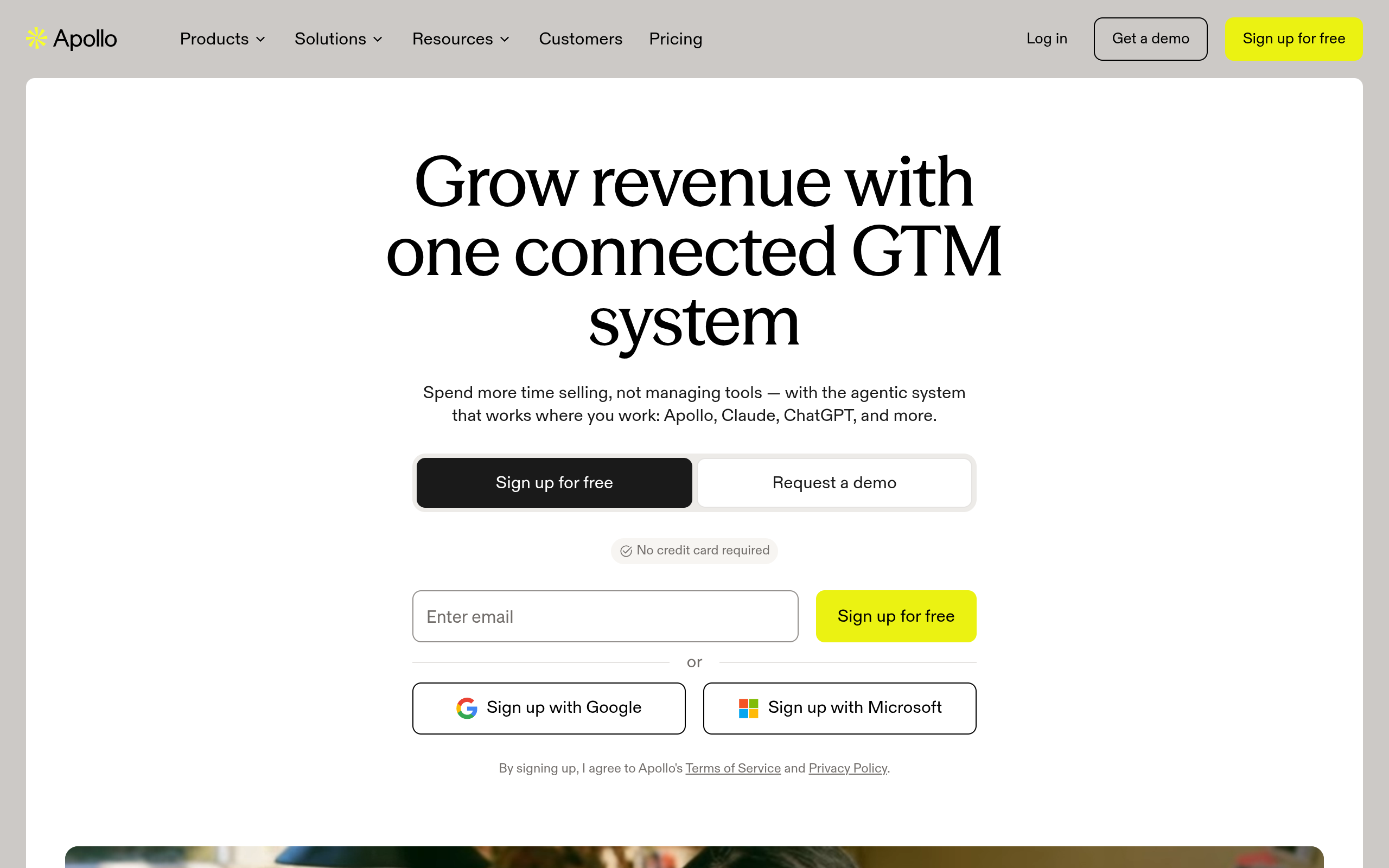
Apollo.io's homepage as of October 2026.
How both platforms are built explains how they behave in daily sales operations. According to an analysis by the Alex Berman Review, Apollo maintains an internal database containing over 275 million contacts and 73 million company profiles.
Apollo functions as an all-in-one engagement hub. According to Seamless.AI's website, the platform operates as a live search engine that crawls an estimated 1.9 billion public web records on demand.
Apollo.io
Apollo combines a large contact database with built-in sales engagement software. Instead of simply pulling raw data, sales reps can build lead lists, send email sequences, and place cold calls within a single dashboard.
An in-depth Apollo.io review clarifies how these modules interact during outbound cadences. The platform also includes intent filters and meeting scheduling tools that connect directly to your CRM.
These cadences have also adapted to external platform policies. A shift documented by JustPricing notes that Apollo adjusted its social sequences after LinkedIn automation rules tightened, converting automated messages into manual SDR task reminders.
There are still clear trade-offs to consider. Apollo charges high credit multipliers on direct dials, and directory records can decay between refresh cycles. Sending unverified contacts too quickly also creates mailbox deliverability risks.
In practice, Apollo suits outbound teams that want database discovery, dialers, and sequencing inside one subscription.
Seamless.AI
Seamless.AI takes a different approach. Rather than relying on a static database, it pulls data from the live web. When you search for a lead, its algorithms scan public websites, corporate domains, and social networks to assemble the record.
Reps frequently capture prospect data directly from professional networks using the Chrome extension. They can then push those records directly into platforms like Salesforce or HubSpot.
That live search helps reps uncover new positions faster than cached directories can. The platform also provides buyer insights, company tech stack details, and CRM data enrichment.
There are clear drawbacks, however. The platform deducts search credits even when no email is found. It also requires twelve-month contracts with auto-renewal clauses and lacks native email sending tools.
Seamless.AI works best for sales reps who prefer manual social prospecting and already have a separate email delivery platform in place.
What Is the Difference Between Apollo and Seamless.AI Workflows
The day-to-day workflow differs substantially between the two platforms. In Apollo, an SDR can identify target accounts, reveal emails, and trigger an automated sequence without switching tabs.
Our breakdown of what is Apollo.io explains how those sequencing tools operate together. That combined setup keeps data sourcing and email outreach inside a single system.
Seamless.AI functions purely as a sourcing engine. A rep collects contacts on the web, exports the records to a CRM, and relies on external sequencers. That workflow leaves your team managing separate subscriptions for data and sending.
Pro tip: If you use Seamless.AI, route raw exports through an external verification tool before importing them into your CRM to prevent polluting your sales records.
TL;DR:
Apollo integrates contact discovery with active email sequencing, while Seamless.AI serves as a real-time web research engine requiring separate email delivery tools.
2. Apollo.io vs Seamless.AI Pricing Plans Compared
Software costs rarely stop at base subscription prices. When comparing Seamless.AI vs Apollo, credit consumption and contract terms create the real difference in total spend.
According to Apollo.io's published pricing, the Basic tier costs $49 per seat per month on annual billing, or $65 billed monthly.
Apollo lists its Professional plan at $79 per seat annually ($99 monthly). Its Organization tier costs $119 per seat annually, or $149 monthly with a three-seat minimum.
Credit mechanics quietly shape your actual spend. A recent breakdown by Bizzy reveals that Apollo deducts one credit for standard email addresses, but charges an eight-credit multiplier for mobile phone numbers.
Unused Apollo credits reset every billing cycle with zero rollover. You can inspect full plan structures in our guide to Apollo pricing.
Seamless.AI gates its paid tiers behind mandatory sales calls. Research by Amplemarket indicates Seamless.AI Pro plans typically run between $79 and $299 per seat per month on annual contracts. Its free plan offers 50 lifetime credits.
Contractual terms present another hurdle. A market audit by Databar.ai highlights that Seamless.AI enforces an automatic renewal clause, requiring written cancellation notice at least 60 days before contract termination.
Reporting by Inbound Labs also shows that Seamless.AI deducts user credits on search queries. The platform charges you even if the engine fails to locate a valid email or phone number.

Skip Recurring Software Subscription Fees
Get verified B2B contact data from Go4Database on demand without paying for expensive recurring software seats.
Head-to-Head Pricing and Commercial Terms
| Commercial Metric | Apollo.io | Seamless.AI | Go4Database |
|---|---|---|---|
| Starting Cost | $49/seat/mo (annual) or $65/mo | Quote-only ($79 to $299/seat/mo) | $0 Free Trial / $35/mo (Nano Plan) |
| Contract Flexibility | Monthly or annual self-serve | Mandatory 12-month lock-in agreements | Flexible pay-as-you-go or monthly |
| Credit Rollover | Zero rollover at monthly reset | Zero rollover at contract reset | Active plan allocation balance |
| Mobile Number Cost | 8 credits per direct dial record | 1 credit per search attempt | Standard contact download record |
| Cancellation Terms | Self-service portal setting | Mandatory 60-day advance notice | Cancel anytime without penalties |
| Dialer & Sequences | Included on paid plans | Requires separate third-party software | Dedicated data file for direct dialers |
If your team prefers buying contact lists on demand instead of managing recurring seat licenses, you can compare plans to source verified records directly.
TL;DR:
Apollo provides self-serve monthly tiers with heavy phone credit multipliers, whereas Seamless.AI requires annual contracts with a strict 60-day cancellation window.
3. Apollo.io vs Seamless.AI: Data Accuracy and Contact Quality
Data accuracy directly influences sender deliverability. Both Google's Email Sender Guidelines and Yahoo's Sender Requirements require bulk senders to configure SPF, DKIM, and DMARC authentication protocols.
SPF is a DNS record identifying authorized sending mail servers. DKIM adds a cryptographic signature to verify domain ownership. DMARC tells receiving servers how to handle messages that fail SPF or DKIM checks.
Google's documentation states that senders should keep spam complaint rates below 0.10% and avoid reaching 0.30%. When you cross that threshold, mail servers can route your outreach straight to spam folders.
Vendor accuracy claims often contrast with field performance. For example, marketing materials on the Seamless.AI website cite accuracy figures between 98% and 99%.
However, independent testing published by RFP.wiki recently recorded bounce rates between 20% and 30%. That gap is largely caused by synthetic syntax guessing on catch-all mailboxes.
A catch-all domain is configured to accept messages sent to any address at that company. Because the server accepts everything initially, automated mailbox verification becomes difficult.
Apollo claims a 91% accuracy rate supported by an automated validation engine. Even so, outbound benchmark reports from Artisan AI and Lume show hard bounce rates between 10% and 15% on marked verified records.
A hard bounce occurs when an email permanently fails because the recipient mailbox does not exist. That delivery failure directly harms your sender reputation.
Protect Deliverability With Verified B2B Data
Acquire thoroughly verified B2B contact data from Go4Database to keep your bounce rates low and outreach safe.
How Can You Protect Mailbox Deliverability When Using Scraped Contacts
A common mistake is treating raw platform exports as ready-to-send lists. Experienced teams run secondary verification before loading contact batches into outreach software.
Running exported lists through a dedicated email verifier catches syntax errors, inactive mailboxes, and spam traps. We covered related data hygiene habits in our breakdown of Apollo.io vs Lusha.
Rather than risk your primary company domain, set up secondary domains to isolate cold outbound volume. That separation protects your core sender reputation as you test new lists.
Pro tip: Separate all catch-all addresses from standard verified records, and test them with a slow drip campaign on secondary domains rather than standard bulk cadences.
TL;DR:
Both platforms return bounce rates higher than their marketing suggests, requiring secondary cleaning tools to protect sending domain reputations.
4. Apollo.io vs Seamless.AI for B2B Lead Generation
Choosing between these platforms really comes down to your daily workflow. The right option depends on where your reps spend most of their working hours.
Apollo makes sense if you want an all-in-one system. When reps discover leads, send email sequences, log calls, and schedule meetings inside a single tool, it keeps your tech stack simple.
Teams evaluating broader enterprise tools often compare features in guides like Apollo vs ZoomInfo. It helps them decide whether an all-in-one platform matches their sales process.
Seamless.AI fits better when reps focus on manual account research across professional networks. Teams with established CRM workflows and standalone sequencers often use its browser extension just to pull verified contact details quickly.
Yet monthly platform subscriptions are not always practical. For lean teams, agencies, and solo founders, paying recurring seat fees makes little sense when you only need a verified list for a specific campaign.
In those situations, sourcing a targeted list directly saves you from managing extra software. Pairing that verified data with modern cold email AI platforms keeps your outreach lean and effective.
TL;DR:
Apollo suits reps wanting an all-in-one execution stack, while Seamless.AI serves sales teams focused purely on manual browser-based list scraping.
5. Which Is Better: Apollo.io or Seamless.AI Alternatives
If neither tool fits your operational model, several competitive platforms provide alternative approaches to B2B prospecting. Exploring wider Apollo.io alternatives can reveal more suitable commercial models.
UpLead
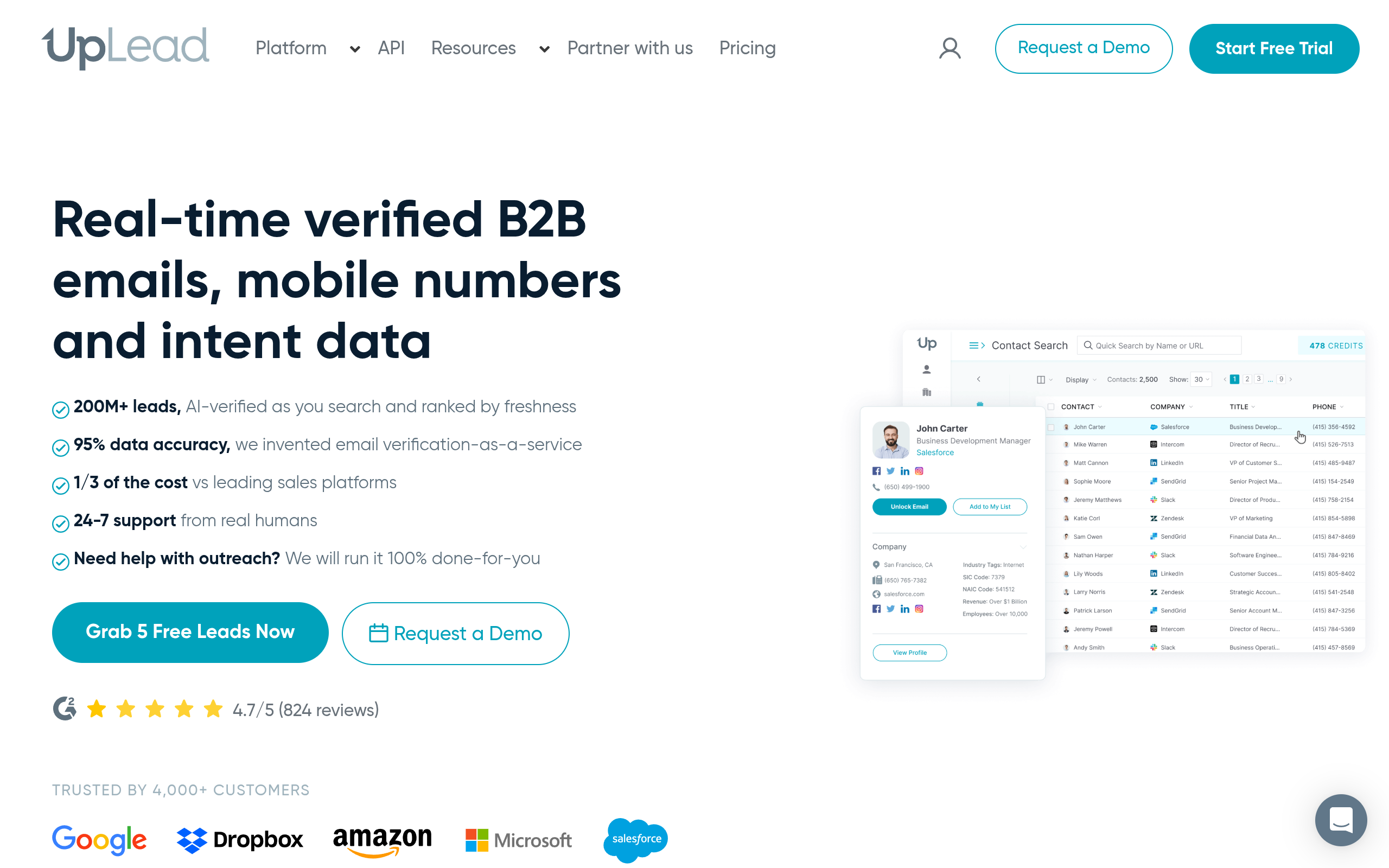
UpLead's homepage as of October 2026.
UpLead prioritizes contact accuracy over raw database volume. It validates email addresses in real time at the moment of download, deducting credits only after verifying that a contact mailbox exists.
The platform provides a 95% accuracy guarantee on verified email downloads, and unused credits roll over each month. The tradeoff is scale: UpLead has a smaller contact directory than Apollo and lacks native multi-channel email sequencers.
UpLead works best for outbound teams focused on deliverability. If credit rollover matters more to your workflow than raw database scale, it is a sensible choice.
Cognism
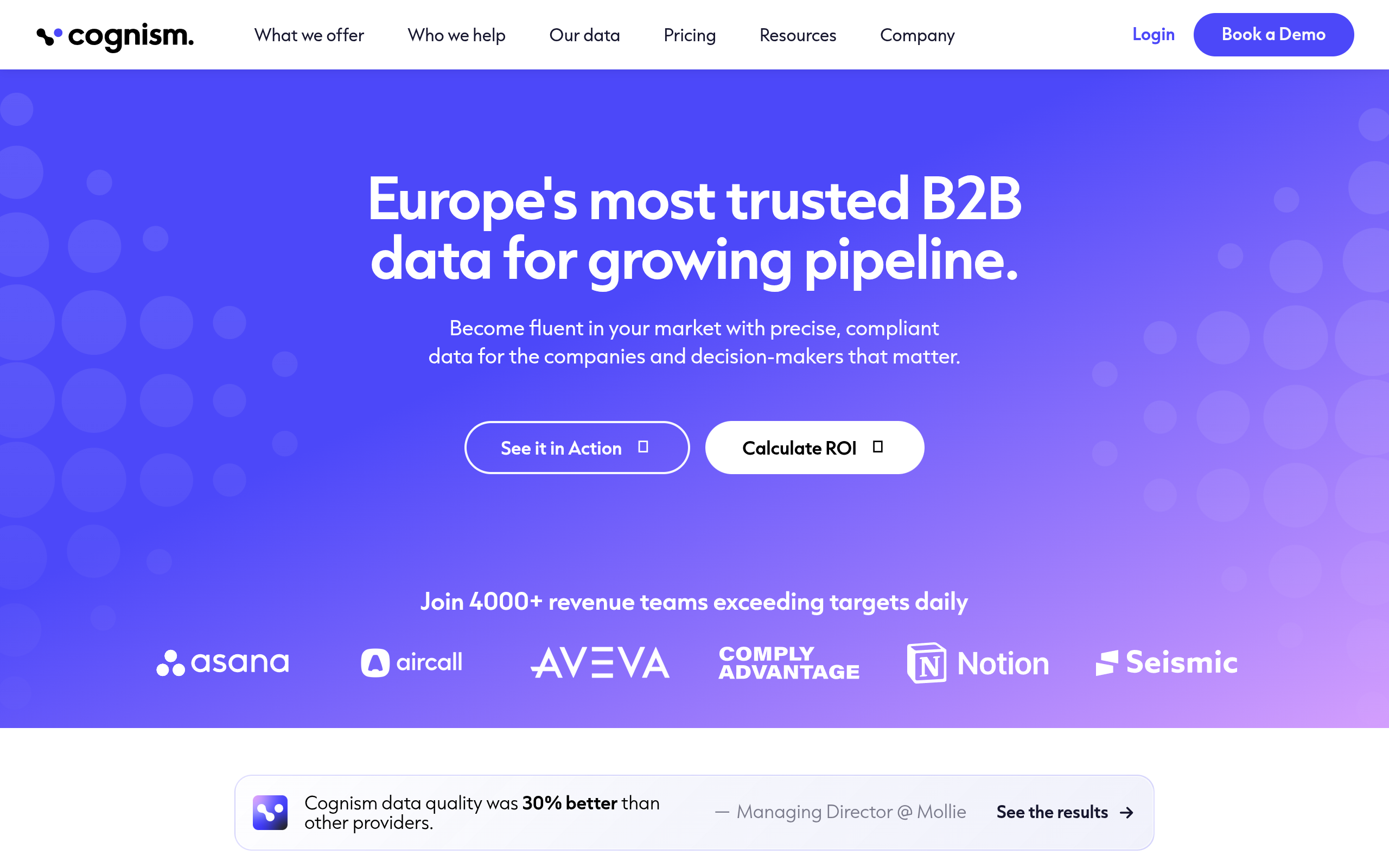
Cognism's homepage as of October 2026.
Cognism focuses on sales teams running heavy cold calling cadences across international territories. Its core strengths are phone-verified mobile numbers and European regulatory compliance.
The platform pairs verified direct dials with intent data powered by the Bombora network. That combination provides reliable contact data, but the purchasing model is strictly enterprise.
Expect annual budget commitments and a longer onboarding setup rather than self-serve monthly plans. Cognism best fits mid-market and enterprise sales teams running structured cold call campaigns across European markets.
Looking for Flexible Prospecting Alternatives
Source customized and verified B2B contact data from Go4Database without locked contracts or software platform overhead.
Go4Database
Go4Database takes a straightforward approach, providing direct access to structured B2B contact lists without recurring seat fees, per-user penalties, or annual contracts. The company provides business emails, verified mobile numbers, and executive details across targeted commercial verticals.
According to Go4Database's site, the platform lists more than 400 million business contacts and 130 million verified mobile numbers across 845 industry categories. Rather than managing complex database tools, teams receive ready-to-use lists tailored to their ideal customer profile.
Entry plans start at $35 per month for 1,500 contacts, based on published plan details. Direct mobile numbers do not require expensive credit multipliers, and flexible monthly terms remove software lock-in.
One clear tradeoff is that the platform lacks native email dispatch software.
Teams pair the data with their preferred cold email sender or CRM, making it a practical fit for lean teams, agencies, and founders wanting verified contacts without seat fees.
TL;DR:
UpLead delivers verified email accuracy, Cognism excels at global mobile calling, and Go4Database provides cost-effective contact lists without software seat overhead.
Diagnosing Your Outbound Stack: Beyond the Data Vendor Lock-In
Before committing thousands of dollars to multi-seat contracts, audit your outbound sales engine honestly. High bounce rates and low reply rates rarely stem from database size alone.
If your ideal customer profile lacks precision or your sender domains have deliverability issues, adding more credits will not solve the problem.
Sourcing verified lists on demand lets you invest in technical domain health and relevant messaging rather than unused software seats.
Frequently Asked Questions
You might have these questions in your mind?